
Career profile

Production Potter

Potters shape clay into ceramic pieces on potter's wheels and with factory equipment.

One well-made bowl is satisfying. Making every batch match takes steady hands, exact measuring and practice that shows in pieces ready for display or sale.
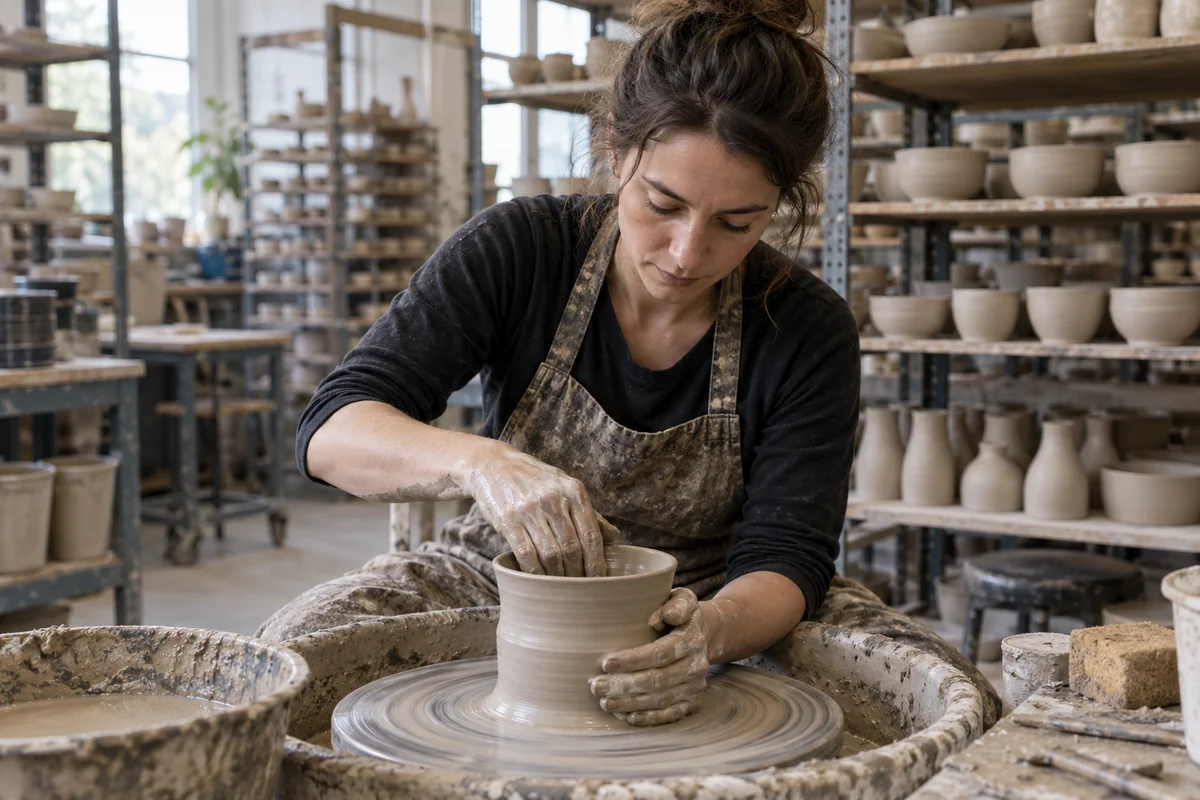
A potter shapes a mug on a pottery wheel in a production studio, next to a row of identical mugs.

A day in the life

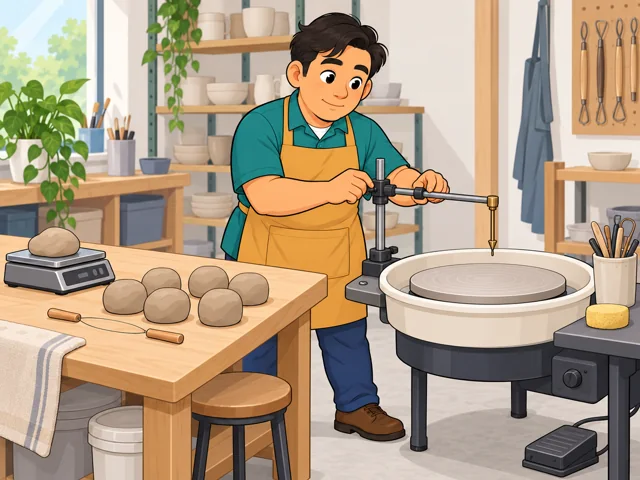
1A production potter adjusts a pointer over a pottery wheel beside a scale and a batch of prepared clay portions.

Weigh clay and set the gauge

In wheel studios, you weigh each clay ball and set a gauge pointer for height and width.
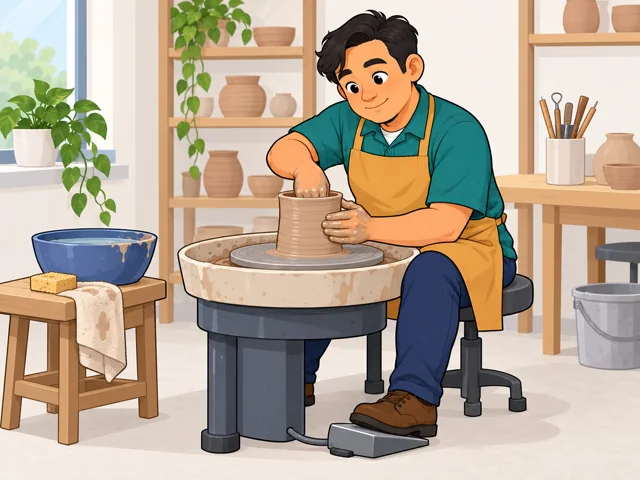
2The seated potter raises a clay pot's walls between his hands while resting his foot on the wheel speed pedal.

Center and pull up walls

Center clay on the spinning wheel, open a hollow, raise the walls and adjust speed once they thin.
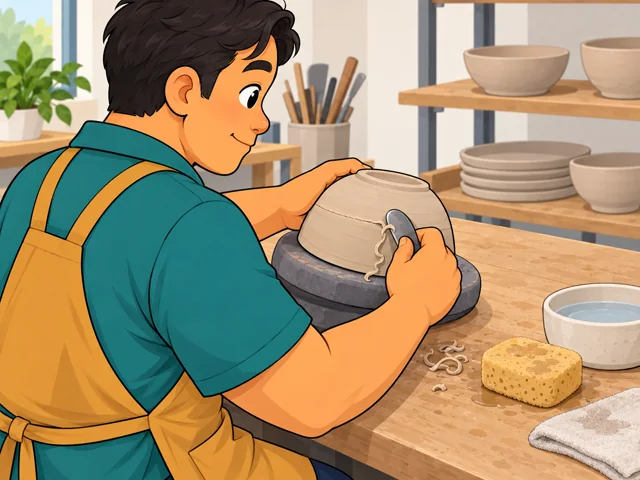
3The potter scrapes a rough seam from an unglazed bowl, with a wet sponge beside the work.

Trim off the rough seam

You work over formed dishes and tableware with a scraper and a damp sponge before glazing.

4The potter checks an unglazed pot's width with calipers and examines its surface under side lighting.

Measure and inspect each piece

Use calipers or a template to check size against the target, then scan the surface for flaws.

Quick facts

Preparation

Workplace training or ceramics study

United States

Pay

Not displayed

Pay depends on the position and location; see hourly examples below.

Outlook

Not displayed

Look locally for pottery manufacturers and production studios.

Quick orientation

Preparation, pay & outlook

Preparation

Workplace training or ceramics study

Some employers teach beginners; clay programs build skills before you apply.

Geography
United States
Period
Not applicable

Pay

Not displayed

Pay depends on the position and location; see hourly examples below.

Geography
United States
Period
Not applicable

Outlook

Not displayed

Look locally for pottery manufacturers and production studios.

Geography
United States
Period
Not applicable

Fit, tradeoffs & changing tools

Things to weigh

  • Repeated hand and shoulder motions, standing, and lifting make this physically demanding work.
  • You have to keep a batch moving while preserving its quality; lingering over every piece can slow production.

Where AI may help

Some factories use automated equipment that forms, removes, and trims a bowl. Machines can take over several repeated handling steps.

What people still lead

People still adjust equipment and judge shapes and surfaces. Hand finishing remains part of some highly mechanized production.

What we can’t predict yet

How much forming and finishing becomes automated will depend on the shapes a shop makes and the equipment it adopts.

Pay in context

Earnings

Use the specific job’s hourly rate, expected hours, and benefits when comparing offers.

Wheel production in Vermont

Farmhouse Pottery lists $20–$22 an hour for production potters in Woodstock, with full-time or part-time positions.

Geography
Woodstock, Vermont, United States
Period
Posting retrieved October 4, 2026
Pay basis
Advertised hourly wage range for a specific employee position

Dinnerware finishing in California

Heath Ceramics lists $25 an hour for a full-time trimming generalist in Sausalito. This is a different role and location, not a guaranteed step up from wheel work.

Geography
Sausalito, California, United States
Period
Posting retrieved October 4, 2026
Pay basis
Advertised hourly wage for a specific employee position

Getting started

Join a production team that trains beginners

What the route involves
Look for beginner production roles where you learn clay processing and finishing from experienced workers.
What it can lead to
You can enter some manufacturing teams without previous clay experience or an art degree.

Study clay before applying

What the route involves
A program such as Haywood Community College’s Professional Crafts—Clay diploma or Associate in Applied Science develops clay-working, glazing, firing, and studio skills.
What it can lead to
You build a technical foundation for production-potter work and a portfolio of pieces.
What to check
Wheel-production employers may require prior throwing experience and a practical demonstration during the interview.

You can learn production skills at work or build a foundation in a ceramics program.

After entry

Career paths

This starts where the entry routes leave off: early work, growing capability, and advancement or specialization.

  1. Get consistent

    Learn the shop’s clay portions and target dimensions. Make repeatable pieces before trying to increase your pace.

  2. Follow a piece through production

    Develop your handling of partly dried clay, trimming, and handle attachment so your work stays consistent beyond the wheel.

  3. Specialize or lead

    Build toward a specialty such as lead glazing, or toward coordinating production as an assistant production manager.

Where you can work

Open production studio

You may throw at a standing wheel while visitors watch and ask questions. Some jobs also include teaching wheel workshops after training.

  • Indoors
  • Physical demands

Dinnerware factory

Your station may focus on finishing pieces made elsewhere in the plant, using wheels and belt equipment. Fixed shifts can start very early.

  • Indoors
  • Shift work
  • Physical demands

Try it

See whether the job clicks before you commit to the path.

Use modeling dough to make five small bowls that match in height and width. Measure them with a ruler, then remake the least consistent one. Notice whether repeating and correcting the same form feels satisfying.

Stay safe: This tests your interest in consistency, not your readiness to operate a pottery wheel or kiln.

Explore more careers

Sources

  1. O*NET OnLine. 51-9195.05 — Potters, Manufacturing. Accessed 2026-10-04.
  2. Farmhouse Pottery. The Making of a Farmhouse Piece. Accessed 2026-10-04.
  3. Farmhouse Pottery. Careers — Production Potter. Accessed 2026-10-04.
  4. Heath Ceramics. Dinnerware Trimming Generalist. Accessed 2026-10-04.
  5. East Fork. Our Process. Accessed 2026-10-04.
  6. Haywood Community College. Professional Crafts — Clay. Accessed 2026-10-04.
  7. Farmhouse Pottery. Meet the Potters. Accessed 2026-10-04.

Your message goes to the Great Jobs team. How we use your information