
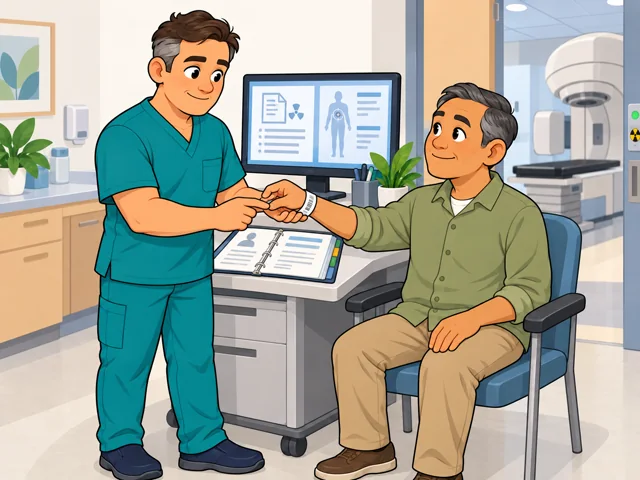
Match the patient to the chart
Confirm that the prescription, diagnosis, chart and patient's identity all agree before the session starts.
Career profile
Radiation therapists position patients and run the machines that deliver doses an oncology team prescribes.
Exact positioning and safety checks sit alongside steady, face-to-face support for people partway through serious treatment.
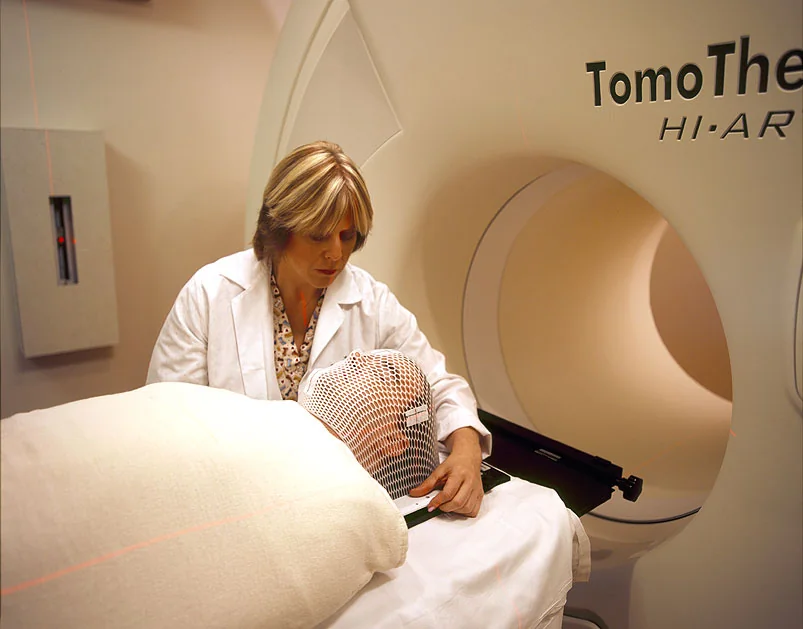
Confirm that the prescription, diagnosis, chart and patient's identity all agree before the session starts.
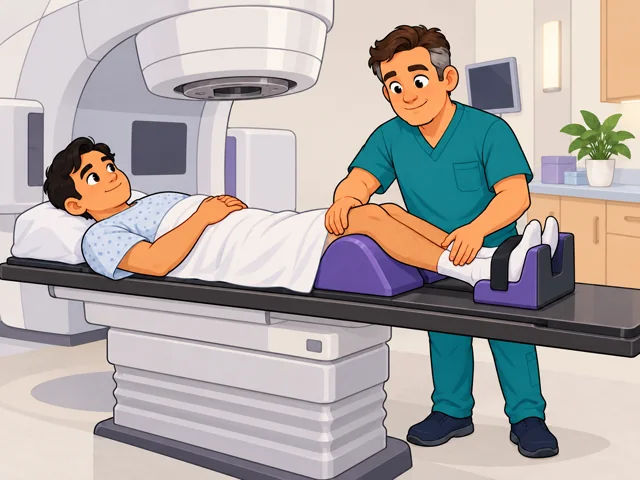
You place the patient exactly and use supports or immobilization devices to hold the prescribed alignment.
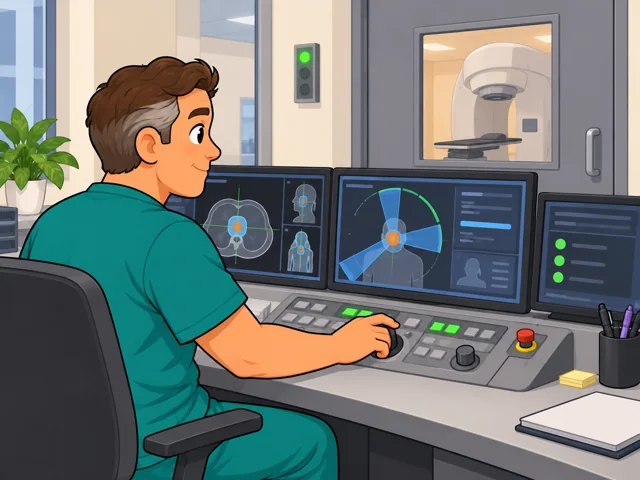
Adjust the controls, finish the safety checks, then run the equipment to deliver the prescribed dose.
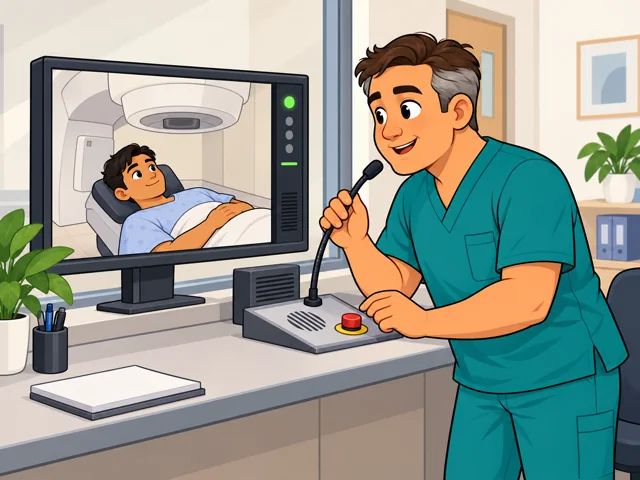
Watch the patient from outside the treatment room, reassure them, and stop treatment or report unusual reactions.

Record the dose given, the equipment settings and any reaction, so the following session starts from correct records.
United States
United States · May 2025
United States · 2025–2035
Quick orientation
This is the typical entry-level education; bachelor's and some post-degree certificate pathways also exist.
U.S. median annual wage in May 2025—half earned more and half earned less. It is not a starting salary.
Projected U.S. employment growth from 2025 to 2035, about as fast as all occupations; local hiring may differ.
Treatment and medical-record systems help store prescriptions, patient data, machine settings, and dose records; treatment equipment carries out controlled beam delivery.
Therapists still verify the patient and prescription, position the body, follow safety steps, watch for reactions, and communicate with the oncology team.
More efficient radiotherapy can reduce the number of visits and may limit employment demand. The size and timing of any staffing change are uncertain.
Pay in context
Workplace setting and location can shift pay.
The median annual wage was $105,310, meaning half of U.S. radiation therapists earned more and half earned less. The median hourly wage was $50.63.
In May 2025, the 10th-percentile annual wage was $80,560 and the 90th-percentile wage was $156,710. These are wage percentiles, not starting and senior salaries.
Median annual wages were $127,680 in outpatient care centers, $110,610 in physician offices, and $104,260 in hospitals.
The American Registry of Radiologic Technologists (ARRT) awards certification and registration after you complete approved education, meet its ethics requirements, and pass its exam. Each route below can meet the education step when its stated degree and program conditions are met; state rules separately determine whether you may practice.
After entry
This starts where the entry routes leave off: early work, growing capability, and advancement or specialization.
In a first role, learn the department's routines for identity checks, chart review, positioning, equipment checks, documentation, and escalation.
Become reliable across repeated setups while learning to catch record mismatches, equipment problems, and changes in a patient's condition.
Experienced therapists may train or supervise students and less-experienced staff.
At a center such as MD Anderson, therapists work with disease-focused physicians, dosimetrists, physicists, and other specialists, with multidisciplinary teams reviewing cases in daily meetings. Smaller hospitals may organize care differently.
UC San Diego describes regional clinics with one or two linear accelerators that coordinate with its four-machine main campus, where some special procedures are performed. Other health systems divide equipment and procedures differently.
Try it
Watch one hospital-made patient-education video about an external-beam treatment visit. Log each moment when the therapist checks identity, positions the patient, leaves the room, watches the treatment, communicates, or records information; then mark which parts look satisfying and which would feel difficult.