
Career profile

Registered Nurse

Registered nurses assess patients' condition and organize the nursing care each one needs.

You weigh what a patient says against what you notice, then pick which problems to act on and bring other clinicians into planning.
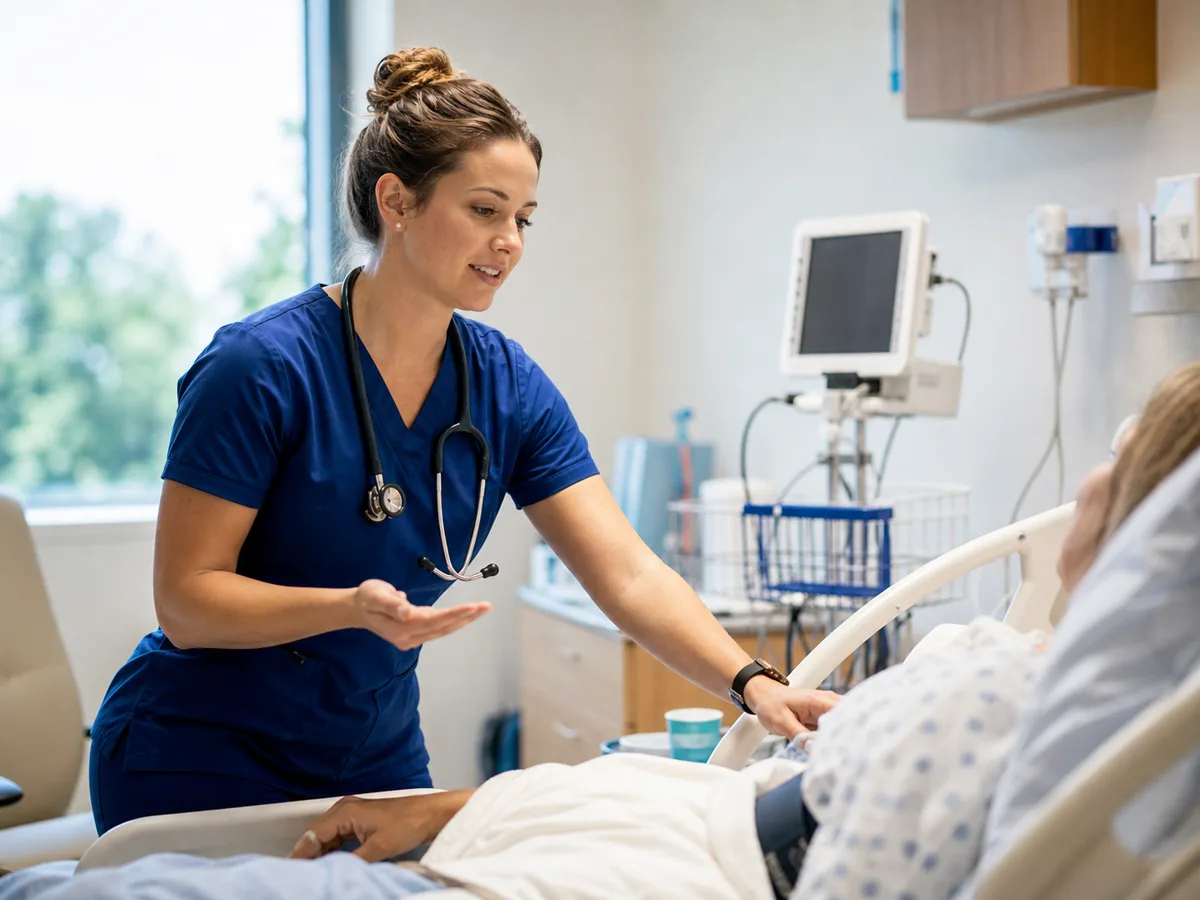
A registered nurse speaks with a patient at a hospital bedside.

A day in the life

1

Check how a patient is doing

Ask how a patient feels, compare current vital signs with past readings, and decide if changes need action.

2

Give medication and watch the response

Give a dose, then watch what it does and write down any reaction that shows up.

3

Revise the plan when progress stalls

If a patient isn't improving, reassess their needs and talk through changes with the physician and other clinicians.

4

Explain care to continue at home

Walk the patient or a family member through care instructions and answer the questions that still confuse them.

5

Update the chart and hand off

Enter what happened in the patient's electronic chart and tell the next nurse about any important changes.

Quick facts

Preparation

Nursing education + license

United States

Pay

$97,550/year

United States · May 2025

Outlook

6% growth

United States · 2025–2035

Quick orientation

Preparation, pay & outlook

Preparation

Nursing education + license

An approved degree or diploma program starts the route to registered nurse (RN) licensure.

Geography
United States
Period
Not applicable

Pay

$97,550/year

National median; $46.90 hourly.

Geography
United States
Period
May 2025

Outlook

6% growth

Projected national employment growth.

Geography
United States
Period
2025–2035

Fit, tradeoffs & changing tools

Things to weigh

  • Bedside work can mean prolonged standing and physically demanding patient care.
  • Illness, emergencies, and suffering can be emotionally hard.
  • Needles and other exposure hazards make protective equipment and safe handling part of everyday work.

Where AI may help

Electronic charts organize patient information. Some systems use artificial intelligence (AI) to prompt nurses to review information or consider a care decision.

What people still lead

You must check suggestions against the person in front of you and remain accountable for the care you give.

What we can’t predict yet

How much routine checking software can safely take over remains unsettled, especially when patient information is incomplete or misleading.

Pay in context

Earnings

The national median is a midpoint across working nurses, not a starting offer.

The pay spread

The lowest-paid 10% earned under $68,940; the highest-paid 10% earned over $137,470.

Geography
United States
Period
May 2025
Pay basis
Annual employee wages; percentile thresholds, not career stages

Workplace matters

Annual medians were $100,220 in hospitals, $91,230 in ambulatory healthcare, and $84,300 in nursing and residential care facilities.

Geography
United States
Period
May 2025
Pay basis
Median annual RN wages within each industry

Openings include replacements

About 180,800 openings are projected annually, including replacement needs.

Geography
United States
Period
2025–2035
Pay basis
Projected average annual openings, not wages or current vacancies

Getting started

Associate degree in nursing

What the route involves
Complete an Associate Degree in Nursing (ADN), studying nursing and practicing patient care.
What it can lead to
This provides an education route toward exam eligibility. After licensure, you can pursue bachelor's completion.
What to check
Some employers require or prefer a bachelor's degree for particular nursing jobs.

Bachelor's degree in nursing

What the route involves
Earn a Bachelor of Science in Nursing (BSN), combining clinical learning with science, community health, and leadership coursework.
What it can lead to
An approved program prepares you for exam eligibility and provides a foundation for later graduate study.

Nursing diploma

What the route involves
Complete an approved nursing diploma program, usually based at a hospital or medical center.
What it can lead to
Graduation provides another education route toward the licensing exam.

Choose an approved program and complete its coursework and supervised clinical practice. Then obtain exam eligibility, pass the National Council Licensure Examination for Registered Nurses (NCLEX-RN), and meet your nursing board's other licensing requirements.

After entry

Career paths

This starts where the entry routes leave off: early work, growing capability, and advancement or specialization. This path also has a credential or licensing boundary; see the requirements and limits.

  1. Get established

    Learn your unit's routines with experienced nurses. Some hospitals combine orientation with residency classes and support from nurse educators.

  2. Build your judgment

    Get better at deciding what needs attention first, communicating concerns, and reviewing difficult care decisions with experienced colleagues.

  3. Lead a shift

    With experience, a charge nurse role can bring responsibility for a unit's nursing work.

    • If you entered through an associate degree or diploma, consider a bachelor's completion program.

Where you can work

Hospital

Care continues overnight; shifts can include weekends and holidays.

  • Indoors
  • Shift work

Physician's office

Business-hour schedules are more likely here.

  • Indoors
  • Office

Home healthcare

Travel to patients and assess how their home surroundings affect care.

  • Field work
  • Travel

Try it

See whether the job clicks before you commit to the path.

Imagine a patient says, “I understand the instructions, but I live alone and can't get to follow-up visits.” Write questions a nurse could ask to understand the problem and identify who could help. Notice whether connecting a person's circumstances with a workable care plan interests you.

Stay safe: Use the fictional situation only; do not recommend treatment.

Explore more careers

Sources

  1. U.S. Bureau of Labor Statistics. Registered Nurses — Occupational Outlook Handbook. Accessed 2026-10-01.
  2. O*NET OnLine. 29-1141.00 — Registered Nurses. Accessed 2026-10-01.
  3. National Council of State Boards of Nursing. Licensure. Accessed 2026-10-01.
  4. National Council of State Boards of Nursing. Approval of Nursing Education Programs. Accessed 2026-10-01.
  5. National Council of State Boards of Nursing. NCLEX Registration. Accessed 2026-10-01.
  6. American Association of Colleges of Nursing. Baccalaureate Education. Accessed 2026-10-01.
  7. American Association of Colleges of Nursing. Degree Completion Programs for Registered Nurses. Accessed 2026-10-01.
  8. Johns Hopkins Medicine. The Johns Hopkins Nurse Residency Program. Accessed 2026-10-01.
  9. American Nurses Association. The Ethical Use of Artificial Intelligence in Nursing Practice. Accessed 2026-10-01.
  10. American Nurses Association. Health & Safety. Accessed 2026-10-01.

Your message goes to the Great Jobs team. How we use your information