
Career profile

Quarry Rock Splitter

Rock splitters break solid rock masses into usable pieces of building stone.

Every good split starts with noticing the grain in the rock, and the job blends careful looking with heavy tools.
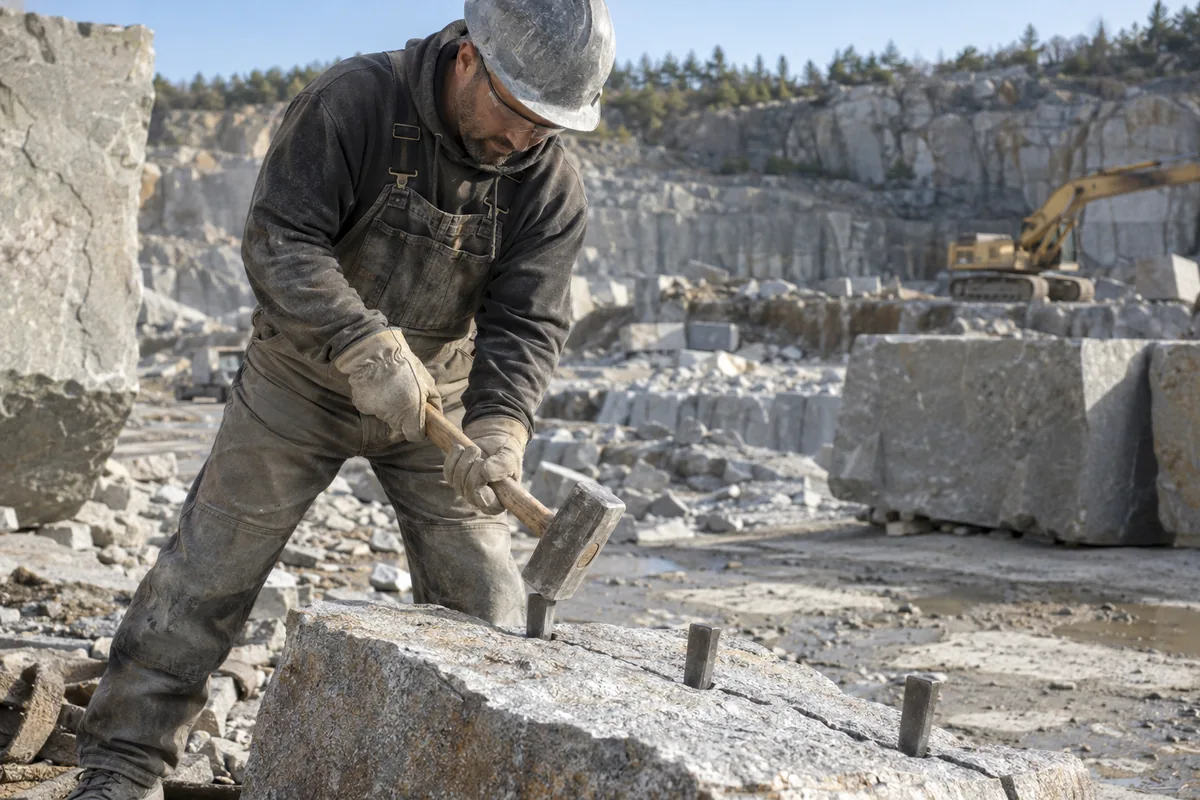
Quarry rock splitter using a hammer and wedges to split a stone block on a quarry floor.

A day in the life

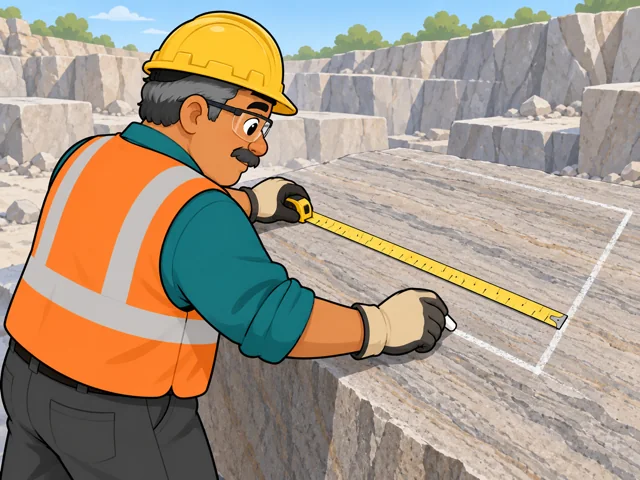
1A quarry worker studies the stone grain while measuring and chalking the outline of the next block.

Chalk out the next block

Trace the grain's direction, measure the block, and chalk its edges where the next split goes.
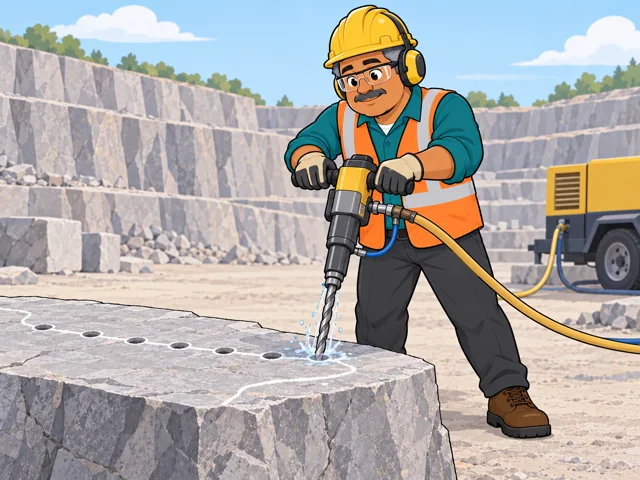
2The worker operates a powered drill to make a row of holes along the chalk outline, with water controlling dust at the drilling point.

Drill holes along the line

Bore a row of holes along the chalk line with a power drill to set up the split.
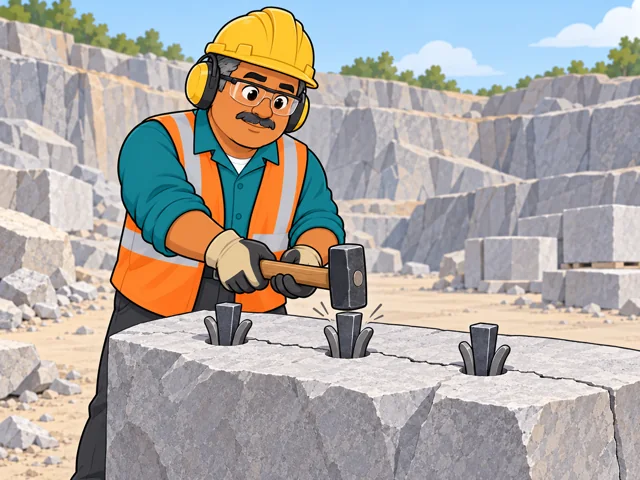
3The worker taps steel wedges between paired metal feathers in drilled holes as a narrow split opens along the stone.

Drive wedges between the feathers

Force steel wedges between pairs of metal feathers so the drilled rock breaks and frees a block.
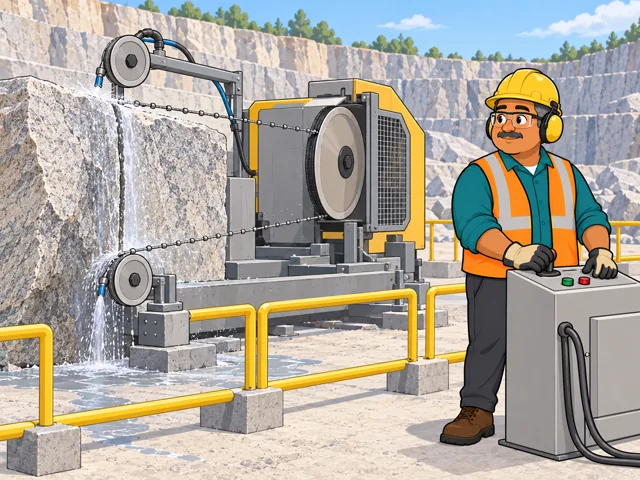
4The worker controls a diamond-wire saw from an offset station while a water-fed wire loop cuts through a granite formation.

Run a diamond wire saw

On certain granite jobs, you slice through the rock with a wire saw, a diamond-beaded wire loop.
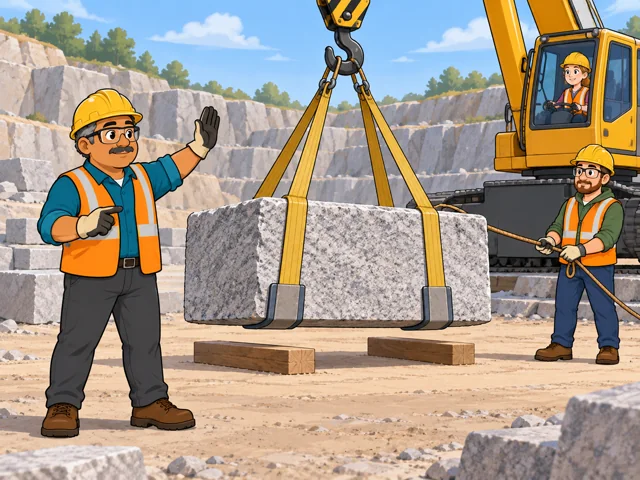
5The worker signals the crane operator as a slung stone block begins to lift, while another coworker controls a tag line from outside the load's path.

Rig slings and guide the lift

You help hook slings onto the block, then direct the crew as they move the freed stone.

Quick facts

Preparation

No formal credential typically needed

United States · 2025–2035

Pay

$48,740 a year

United States · May 2025

Outlook

5.8% projected growth

United States · 2025–2035

Quick orientation

Preparation, pay & outlook

Preparation

No formal credential typically needed

Employer requirements vary; learning the equipment and mine safety procedures is still essential.

Geography
United States
Period
2025–2035

Pay

$48,740 a year

National median for quarry rock splitters, equivalent to $23.44 an hour.

Geography
United States
Period
May 2025

Outlook

5.8% projected growth

About 400 openings a year nationally, including replacement openings.

Geography
United States
Period
2025–2035

Fit, tradeoffs & changing tools

Things to weigh

  • Long periods standing, loud equipment and vibration can make the work tiring.
  • Some crews start early and work long days outdoors; weather can change the day’s tasks.

Where AI may help

Powered wire saws handle long cuts through granite, while hand splitting remains part of stone production.

What people still lead

People judge how cracks, seams and the stone’s condition affect the blocks they can recover.

What we can’t predict yet

How much of that judgment machines can take over remains uncertain, especially when each piece of stone behaves differently.

Pay in context

Earnings

The national median is $48,740 a year, or $23.44 an hour. Treat it as a comparison point when you look at an actual offer.

The national spread

The 10th-to-90th-percentile range is $37,340–$67,710 a year, or $17.95–$32.55 an hour. These are wage percentiles, not a beginner-to-expert pay ladder.

Geography
United States
Period
May 2025
Pay basis
Annual and hourly wage estimates for wage-and-salary workers in SOC 47-5051.

Check the hours behind the offer

Some quarry jobs include overtime pay. Compare the hourly rate, expected weekly hours and overtime terms before judging what you could earn.

Geography
United States
Period
Not stated
Pay basis
Employer-specific hourly pay and overtime arrangements; no national premium is claimed.

A small national hiring market

Employment is projected to grow 5.8% from 2025 to 2035, with about 400 openings annually from growth and replacement needs. That does not tell you whether a nearby quarry is hiring.

Geography
United States
Period
2025–2035
Pay basis
Employment projection for SOC 47-5051; openings are an annual average, not a wage measure.

Getting started

Join a crew that trains beginners

What the route involves
Learn drilling, sawing and quarry equipment through employer training.
What it can lead to
You can enter extraction work without previous quarry experience when the employer accepts beginners.
What to check
At surface-stone mines covered by Mine Safety and Health Administration (MSHA) Part 46, new miners need at least four hours of specified training before work and 24 hours total within 90 days. Until that training is complete, an experienced miner must be able to observe your work. Task-specific hazard training comes before hands-on practice.

Bring stonework or construction experience

What the route involves
Build hands-on experience in stonework, construction or another quarry job, then apply for extraction work.
What it can lead to
Related experience can meet an employer’s preference for applicants already familiar with physical site work.
What to check
Previous experience does not replace training for a new mine’s hazards or unfamiliar equipment.

Look for quarry worker jobs that provide training, or bring related hands-on experience.

After entry

Career paths

This starts where the entry routes leave off: early work, growing capability, and advancement or specialization.

  1. Get established

    Make accurate marking and careful tool handling consistent habits.

  2. Broaden your skills

    Cross-train on drilling and sawing so you can handle more of the extraction process.

  3. Specialize in cutting

    Develop wire-saw expertise in granite extraction, including working around natural seams that limit block size.

Where you can work

Granite quarry crews

Some crews move among several quarries and rotate between hand drilling, line drilling and wire sawing. Expect outdoor work and changing equipment.

  • Outdoors
  • Physical demands
  • Safety-sensitive

Custom slate quarries

The bed of stone you work can depend on an order’s color and size requirements. Keeping blocks from freezing or drying out matters because their condition affects splitting.

  • Outdoors
  • Physical demands
  • Safety-sensitive

Try it

See whether the job clicks before you commit to the path.

Compare close-up photographs of rough granite and slate. Sketch the layers, seams or cracks you notice, then mark where you would want more information before planning a block. Does studying the material hold your attention?

Stay safe: Keep this a photo exercise; it does not teach safe cutting or splitting.

Explore more careers

Sources

  1. O*NET OnLine. Rock Splitters, Quarry — 47-5051.00. Accessed 2026-10-09.
  2. U.S. Bureau of Labor Statistics. May 2025 Occupational Employment and Wage Statistics — national estimates, SOC 47-5051. Accessed 2026-09-29.
  3. U.S. Bureau of Labor Statistics. Employment Projections Table 1.2 — 2025–2035, SOC 47-5051. Accessed 2026-09-29.
  4. Freshwater Stone. Granite Quarry Worker. Accessed 2026-10-09.
  5. Georgia Stone Industries, Inc., via U.S. Department of Labor. Dimensional Granite Surface Miner — H-400-26001-525171. Accessed 2026-10-09.
  6. Vermont Structural Slate. About — Quarries and Production Process. Accessed 2026-10-09.
  7. Mine Safety and Health Administration / eCFR. 30 CFR 46.5 — New miner training. Accessed 2026-10-09.
  8. Mine Safety and Health Administration. Part 46 Training Pamphlet — New Training Requirements for Surface Non-Metal Mines. Accessed 2026-10-09.

Your message goes to the Great Jobs team. How we use your information