
Career profile

Structural Iron and Steel Worker

Ironworkers assemble steel frameworks that hold up structures like bridges and large buildings.

Like assembling things? Here you help lift heavy steel beams, join them into a frame, and watch a structure grow around you.
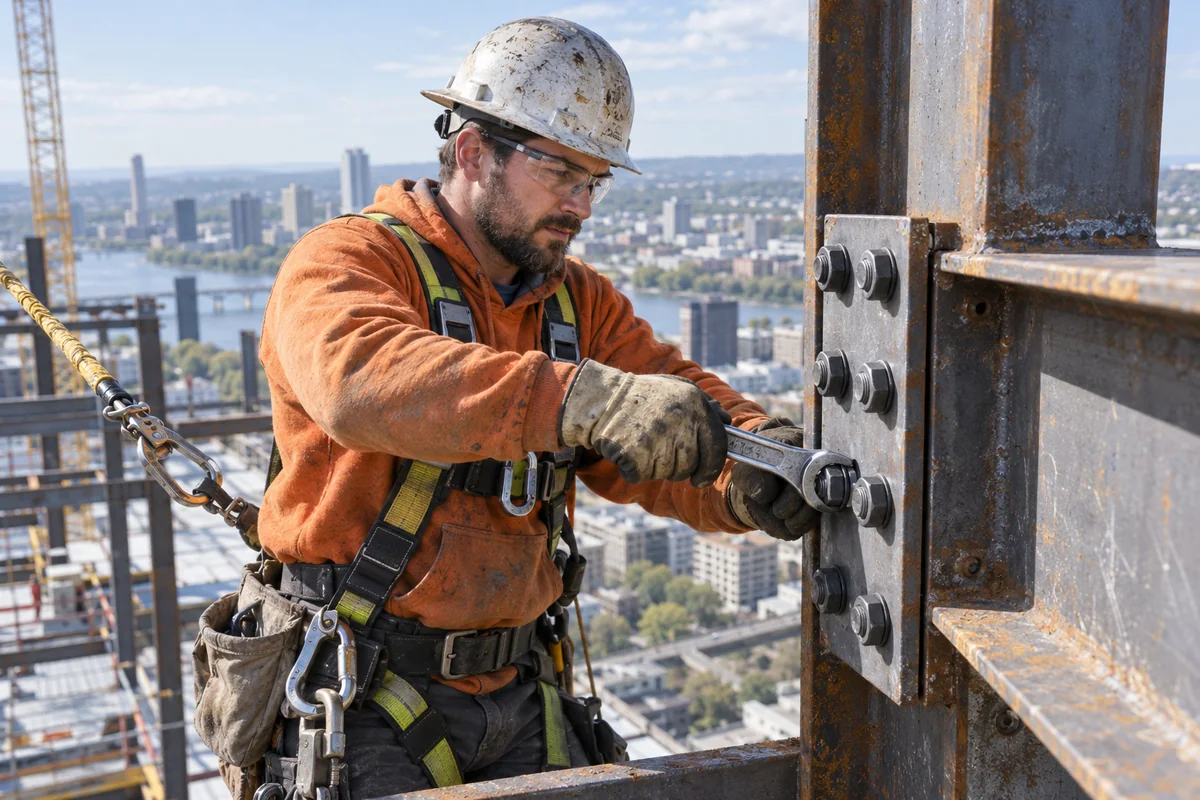
An adult structural ironworker securing a steel beam connection high on a construction frame with proper fall protection.

A day in the life

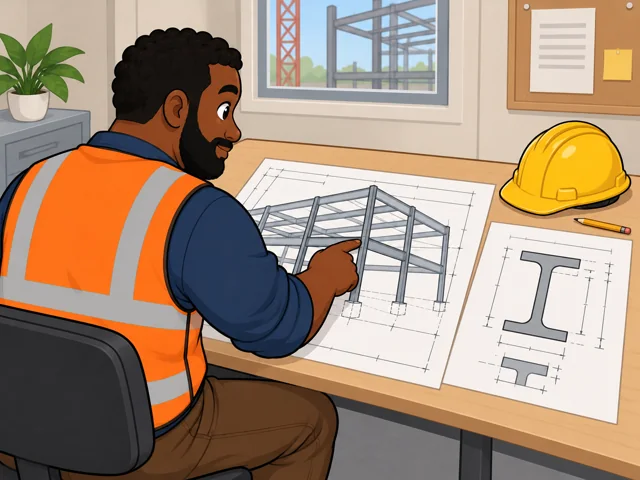
1An ironworker compares a beam detail with its intended position on a structural drawing at a planning table.

Find a beam's place on paper

Study the drawing or plan to learn a steel piece's size and where it belongs in the frame.
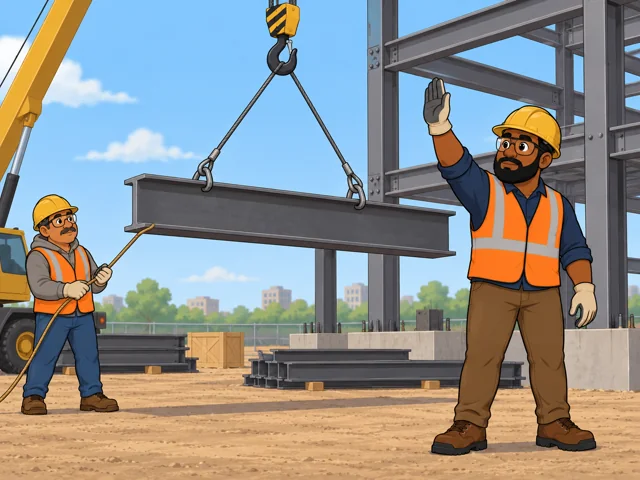
2An ironworker signals a crane operator as a medium-tan coworker guides a suspended steel beam with a tag line; both stand clear of the load.

Guide the crane's lift

Look over the hooks and cables, then signal the crane operator as the steel moves toward its spot.
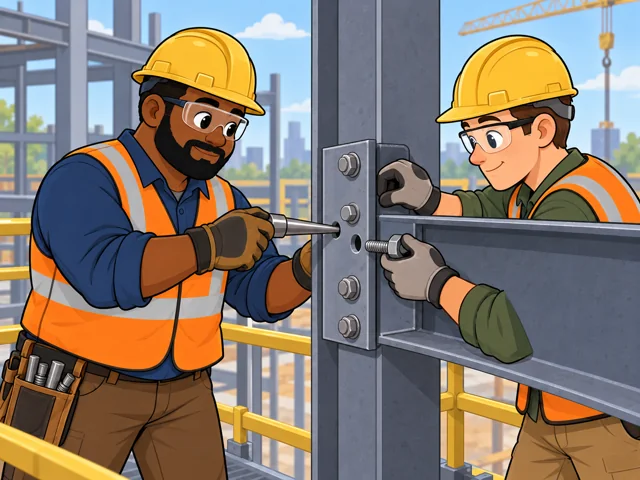
3An ironworker aligns steel connection holes with a drift pin while a light-skinned coworker inserts a bolt from a guardrailed platform.

Pin the holes, then bolt

Use drift pins to bring the bolt holes into line, then bolt the steel pieces into a joint.
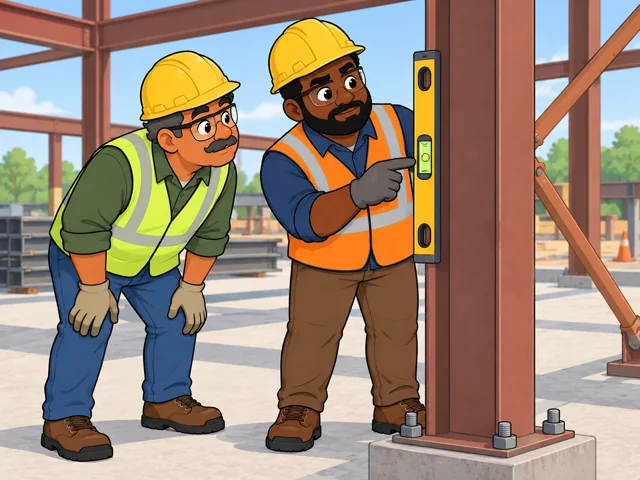
4An ironworker checks a steel column with a spirit level and shows a medium-tan coworker the off-center bubble indicating that alignment needs adjustment.

Confirm the frame stands straight

Test the frame with a laser or a level, and any steel out of line has to move.

Quick facts

Preparation

Usually an apprenticeship

United States · 2025

Pay

$62,780 a year

United States · May 2025

Outlook

3.1% projected growth

United States · 2025–2035

Quick orientation

Preparation, pay & outlook

Preparation

Usually an apprenticeship

Typical preparation combines a high school diploma or equivalent with learning the trade on the job.

Geography
United States
Period
2025

Pay

$62,780 a year

National median for structural iron and steel workers; $30.18 an hour.

Geography
United States
Period
May 2025

Outlook

3.1% projected growth

About 5,900 openings per year nationally, averaged over 2025–2035.

Geography
United States
Period
2025–2035

Fit, tradeoffs & changing tools

Things to weigh

  • Heavy work and heights bring strain and serious fall risks; protective equipment is essential.
  • Jobs may require travel. Wet, icy, or very windy conditions can stop work at height.

Where AI may help

Researchers are testing digital instructions overlaid on real steel parts, called augmented reality, to assist fabrication before pieces reach the site.

What people still lead

On site, workers still judge alignment and coordinate moving steel with the crane operator.

What we can’t predict yet

How far digital guidance will extend from fabrication into changing field conditions—and how much positioning it could automate—remains uncertain.

Pay in context

Earnings

Apprentice pay can rise as your skills develop.

The national range

The median was $62,780 annually, or $30.18 hourly. The lowest 10% earned under $44,580; the highest 10% earned over $108,260. These are wage ranges, not career stages.

Geography
United States
Period
May 2025
Pay basis
Employee wage median and 10th/90th percentile thresholds

Workplace pay differs

Annual medians were $73,470 in heavy and civil engineering construction, $63,340 with foundation, structure, and building exterior contractors, and $61,930 in nonresidential building construction.

Geography
United States
Period
May 2025
Pay basis
Industry-specific median employee wages for structural iron and steel workers

Openings beyond new jobs

The projected 5,900 annual openings include replacement needs. They are a national forecast, not a count of jobs available near you today.

Geography
United States
Period
2025–2035
Pay basis
Employment projection; not compensation

Getting started

Enter an apprenticeship

Usually 3–4 years.Paid
What the route involves
Work alongside experienced ironworkers and attend classes and hands-on training.
What it can lead to
Completing the program earns journey-level recognition.
What to check
A diploma or equivalent is generally required; check the sponsor's admission rules.

Learn through an employer

What the route involves
Train on the job to use tools and construct frameworks.
What it can lead to
Build working skills through employer-provided training.
What to check
Training length varies; some employers do not require a diploma.

Two routes combine employment with learning the trade.

After entry

Career paths

This starts where the entry routes leave off: early work, growing capability, and advancement or specialization.

  1. Get established

    Build reliable habits with tools, drawings, and the crew while learning to assemble framing.

  2. Develop precision

    Become more capable at aligning members and completing connections.

  3. Lead a crew

    Experience can lead to supervising other ironworkers.

Where you can work

New building sites

You assemble delivered steel into commercial or industrial building frames. Your work depends on the lifting sequence and coordination with the crane crew and other trades.

  • Outdoors
  • Field work
  • Physical demands
  • Safety-sensitive

Bridges and facilities being repaired

Some crews replace steel while a structure remains in service. Restricted access, live rail lines, or operating equipment can shape when and how the crew reaches a connection.

  • Field work
  • Physical demands
  • Safety-sensitive

Try it

See whether the job clicks before you commit to the path.

Sketch a small frame with numbered columns and beams, then recreate it on a table using cardboard strips and tape. Check each connection against your drawing. Notice whether you enjoy translating a plan into aligned parts.

Stay safe: Keep it tabletop-sized; this explores assembly, not readiness for heights or steel erection.

Explore more careers

Sources

  1. O*NET OnLine. 47-2221.00 — Structural Iron and Steel Workers. Accessed 2026-10-03.
  2. U.S. Bureau of Labor Statistics. Table 1.2 Occupational projections, 2025–35, and worker characteristics, 2025. Accessed 2026-10-03.
  3. U.S. Bureau of Labor Statistics. Occupational Outlook Handbook — Ironworkers. Accessed 2026-10-03.
  4. Ironworkers Organizing. Apprenticeship. Accessed 2026-10-03.
  5. American Institute of Steel Construction. Augmented Reality in Structural Steel Construction [T8] 2025. Accessed 2026-10-03.
  6. River City Ironwork. Industrial Ironwork & Field Construction. Accessed 2026-10-03.

Your message goes to the Great Jobs team. How we use your information