
Career profile

Subway or Streetcar Operator

Subway and streetcar operators move city riders by subway, streetcar, light rail, or elevated train.

Every station asks for fresh attention: signals to read, people near the platform edge to watch, and a vehicle to bring through safely.
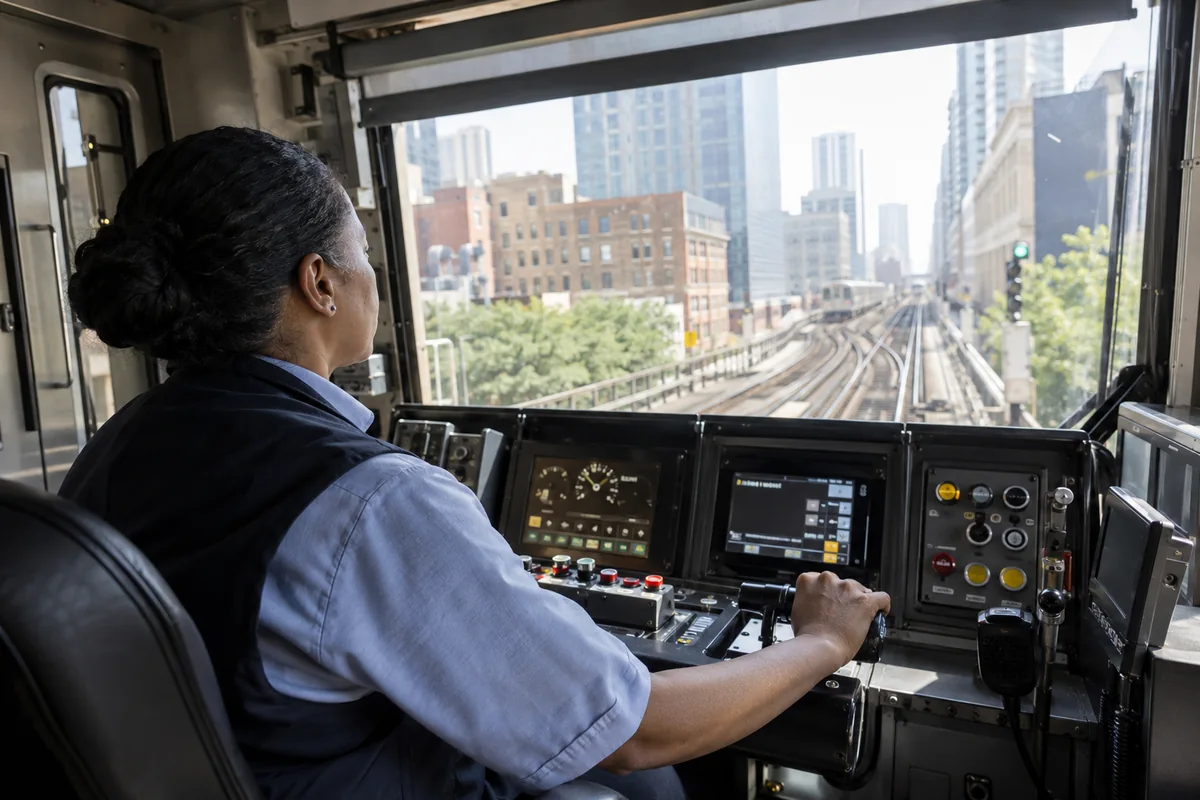
Subway or streetcar operator seated at a train control console looking down the track through the windshield.

A day in the life

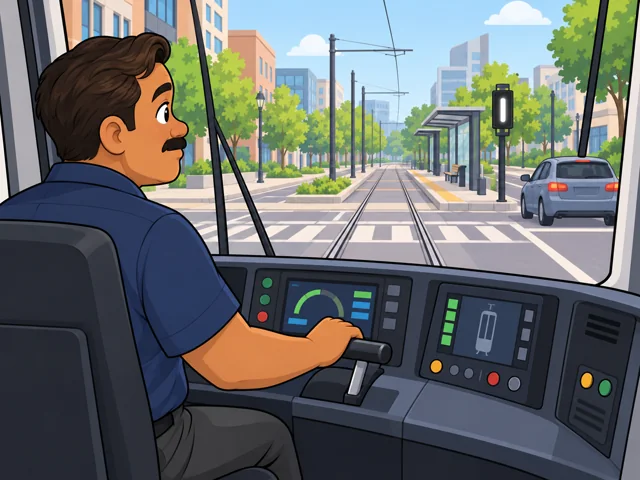
1A streetcar operator adjusts the controls while watching a track signal and a car waiting beside the crossing as he approaches a stop.

Ease into the station

Adjust speed with the controls as you arrive, watching signals and any street traffic crossing the rails.
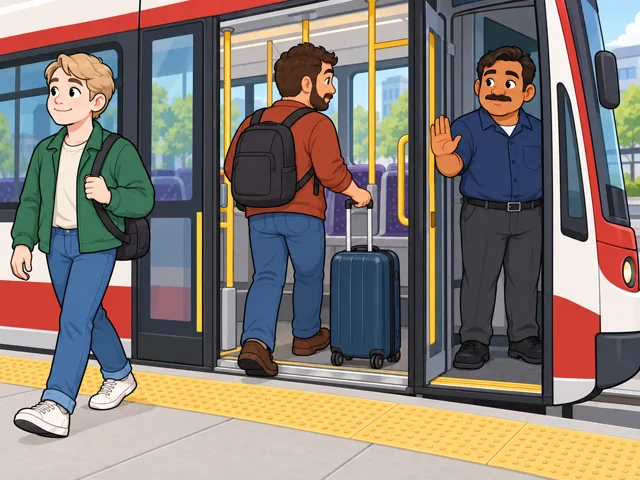
2The operator holds departure while an adult passenger pulls a rolling bag clear of the open doorway and another passenger finishes exiting.

Keep the doorways clear

Watch riders board and leave, and handle anyone blocking a door before you pull away.
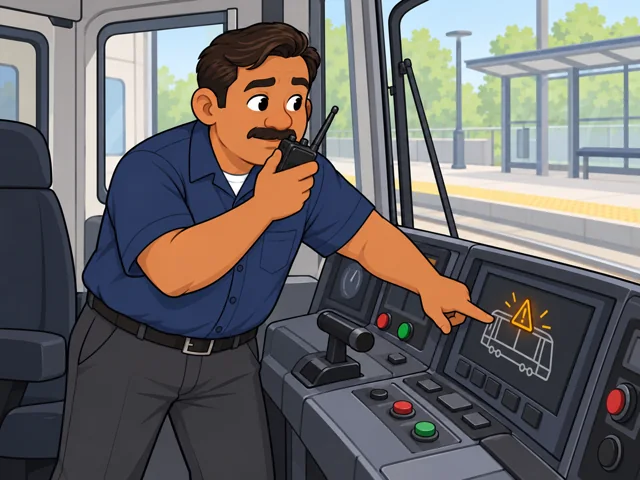
3Inside the stopped streetcar, the operator checks a fault display and radios for help.

Find what stopped the train

If a vehicle fault halts service, find the cause and radio for help if you cannot fix it.
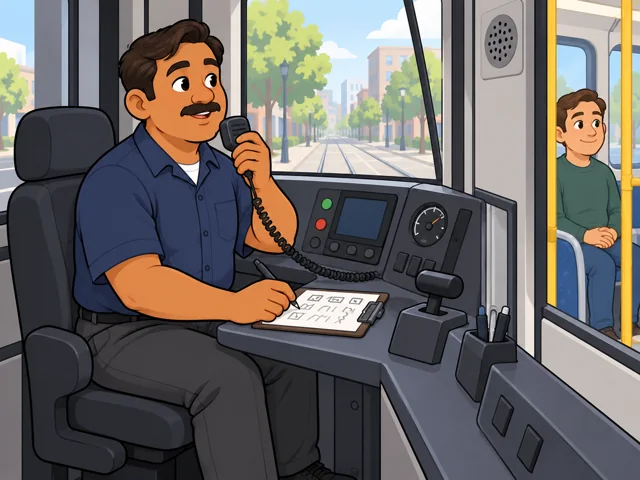
4The operator explains the delay over the passenger speaker while recording the incident and his response on a clipboard.

Tell riders, then write it up

Use the announcement system to tell riders what's happening, then write up the event and your response.

Quick facts

Preparation

High school diploma or equivalent

United States

Pay

$86,380 median

United States · May 2025

Outlook

3.7% projected growth

United States · 2025–2035

Quick orientation

Preparation, pay & outlook

Preparation

High school diploma or equivalent

Employer training follows hiring; experience and screening requirements vary.

Geography
United States
Period
Not applicable

Pay

$86,380 median

About $41.53 an hour nationally for subway and streetcar operators.

Geography
United States
Period
May 2025

Outlook

3.7% projected growth

About 900 openings a year on average, including replacement openings.

Geography
United States
Period
2025–2035

Fit, tradeoffs & changing tools

Things to weigh

  • Shifts can include nights, weekends and holidays.
  • Long periods sitting come with noise and occasional climbing or walking along the railway.
  • A missed signal or hazard can have serious consequences.

Where AI may help

On Bay Area Rapid Transit (BART), computers control most mainline speed, train spacing and station stops. This is called automatic train operation.

What people still lead

Operators still watch for hazards, handle vehicle problems and respond when the trip stops going normally.

What we can’t predict yet

How much driving becomes automated depends on the system. A streetcar sharing lanes with cars presents different conditions from an automated rapid-transit line.

Pay in context

Earnings

The national median was $86,380 a year, or $41.53 an hour, in May 2025.

The national spread

The 10th-to-90th-percentile range was $55,180–$90,140 annually. These are positions in the pay distribution, not starting and experienced-worker rates.

Geography
United States
Period
May 2025
Pay basis
Annual wage estimates for subway and streetcar operators, SOC 53-4041

Look for a pay progression

An agency may raise your rate through scheduled steps. TriMet describes this for new light rail operators; check the hiring notice for the applicable progression.

Geography
Portland, Oregon
Period
Accessed 2026-10-09
Pay basis
Employer hourly wage progression; no national rate implied

Openings include replacements

Employment is projected to grow 3.7% from 2025 to 2035, with about 900 openings annually on average. Openings include replacing people who leave the occupation, not just new positions.

Geography
United States
Period
2025–2035
Pay basis
Employment projection for SOC 53-4041; not a compensation measure

Getting started

Enter through a rail trainee job

Paid
What the route involves
At TriMet in Portland, you learn through classes, simulations and hands-on rail operation.
What it can lead to
Successful training prepares you to operate light rail without first working as a bus driver.
What to check
TriMet requires a year transporting people or products, a year in customer service, and three years of driving with a good record. You must meet physical requirements, pass drug and background checks, and be able to obtain an Oregon or Washington Commercial Driver’s License. If you lack that license, obtain its learner permit during the conditional-offer process, then earn the license through TriMet’s on-the-job training.

Build qualifying public-facing experience

What the route involves
For BART, combine a diploma or equivalent with three years of verifiable, full-time-equivalent experience interacting with the public.
What it can lead to
You meet the education and experience requirements for consideration as a train operator.
What to check
BART also requires a valid California driver’s license, satisfactory driving record, a medical examination and obtaining and maintaining its train-operator certification.

A diploma or equivalent is the usual educational starting point. Direct rail recruitment can bypass prior bus employment, but still requires experience.

After entry

Career paths

This starts where the entry routes leave off: early work, growing capability, and advancement or specialization.

  1. Get established

    Make route knowledge and operating routines dependable through daily use of what you learned in training.

  2. Handle disruptions

    Build skill in locating vehicle faults and coordinating a response when normal service breaks down.

  3. Lead or specialize

    A possible next step at BART is Operations Foreworker, supervising rail operations on a shift.

    • Develop the manual operating skills used on test tracks when new railcars are being checked.

Where you can work

Automated rapid transit

On systems such as BART, computers handle much of the movement between stations. Your attention stays on the train, platform hazards and problems that interrupt service.

  • Vehicle
  • Shift work
  • Safety-sensitive

Streetcars in city traffic

On Portland’s streetcar routes, much of the track shares the road with cars, buses and trucks. Pedestrian areas and intersections add activity close to your vehicle.

  • Vehicle
  • Shift work
  • Safety-sensitive

Try it

See whether the job clicks before you commit to the path.

If you can take a short subway or streetcar ride, note what changes at five consecutive stops: boarding crowds, announcements and time spent waiting. Would repeatedly watching for small changes hold your attention?

Stay safe: Observe from normal passenger areas without distracting the operator; the usual fare may apply.

Explore more careers

Sources

  1. O*NET OnLine. Subway and Streetcar Operators — 53-4041.00. Accessed 2026-10-09.
  2. U.S. Bureau of Labor Statistics. May 2025 Occupational Employment and Wage Statistics, national estimates — SOC 53-4041. Accessed 2026-09-29.
  3. U.S. Bureau of Labor Statistics. Employment Projections, Table 1.2, 2025–2035 — SOC 53-4041. Accessed 2026-09-29.
  4. Bay Area Rapid Transit. Train Operator — Class Specification OB160. Accessed 2026-10-09.
  5. Bay Area Rapid Transit. Join us in celebrating Transit Driver Appreciation Day. Accessed 2026-10-09.
  6. Bay Area Rapid Transit. The 1,000th Fleet of the Future car was just delivered. Here's what happens next.. Accessed 2026-10-09.
  7. TriMet. Fast Track to MAX. Accessed 2026-10-09.
  8. Portland Bureau of Transportation. Portland Streetcar Development Standards, 2025 edition. Accessed 2026-10-09.

Your message goes to the Great Jobs team. How we use your information