
Career profile

Telecommunications Line Installer and Repairer

Telecom line installers put in and fix lines bringing television, phone, and internet to people.

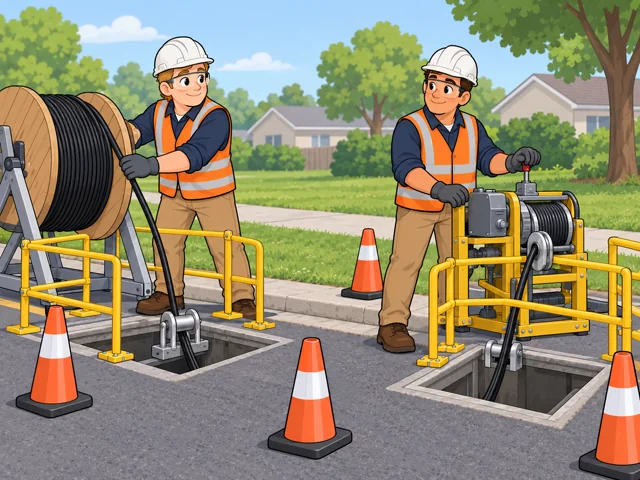
Pulling cable through a buried duct, then hunting down what's blocking a signal, shows the range here: hard outdoor labor and careful, step-by-step troubleshooting.
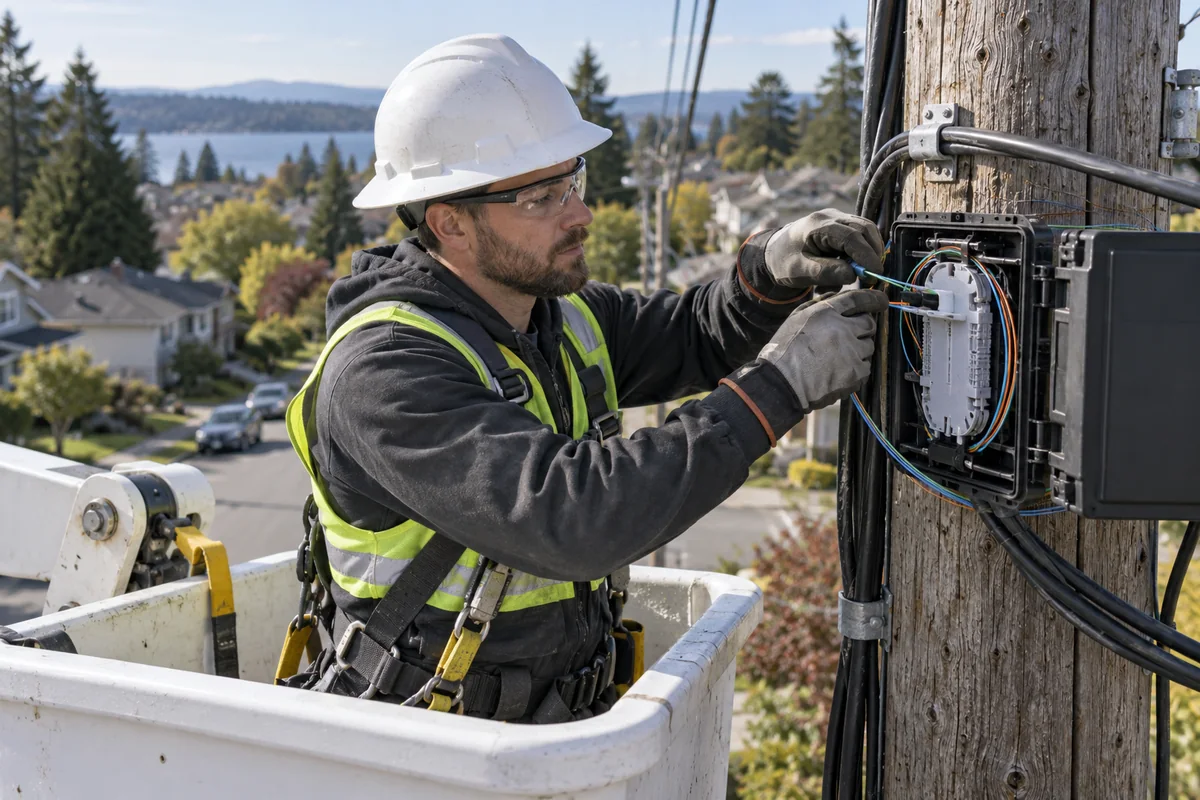
An adult telecommunications line installer wearing a hard hat and safety harness working from a utility bucket truck, carefully connecting fiber cable on a street pole.

A day in the life

1A telecommunications technician operates a winch while a coworker monitors cable feeding from a reel into an underground duct.

Winch new cable underground

With your crew, feed cable off its reel as a winch draws it into a buried duct.
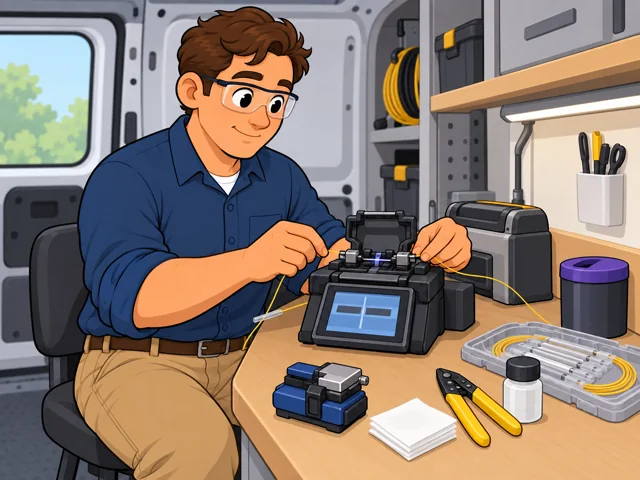
2A seated technician carefully loads prepared glass fiber ends into a fusion splicer, with a protective sleeve ready beside the joint.

Join thin strands of glass

On fiber jobs, prep the ends, fuse them with heat in a fusion splicer, and shield the splice.
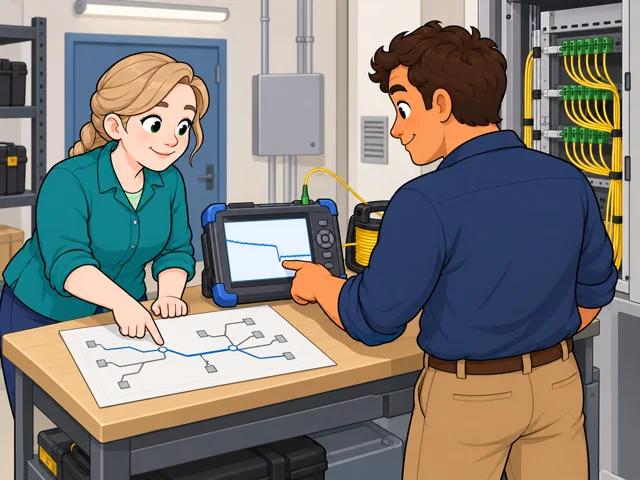
3A technician points to a drop on a fiber tester’s graph while a coworker traces the corresponding section of a cable-route diagram.

Find where the signal drops

Match the tester's graph to the cable route, and a surprise dip flags a connection or damaged stretch.
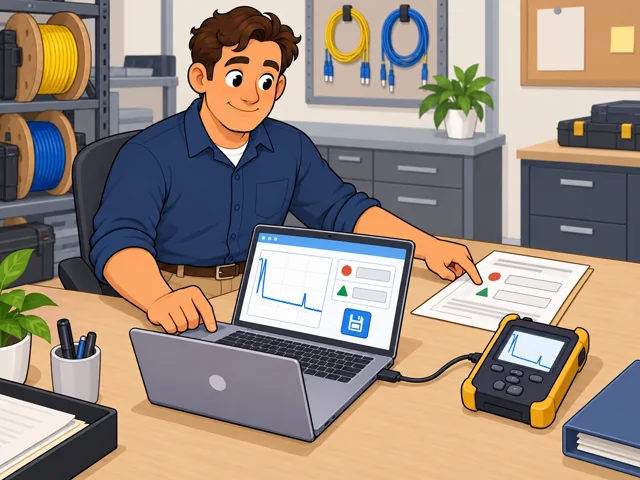
4A technician checks cable and fiber identifiers against a work record and saves the fiber test results on a laptop.

Record test results per fiber

Log results under the fiber and cable IDs so a tech chasing trouble later has readings to compare.

Quick facts

Preparation

High school + workplace training

United States · 2025

Pay

$74,330/year

United States · May 2025

Outlook

3.4% projected decline

United States · 2025–2035

Quick orientation

Preparation, pay & outlook

Preparation

High school + workplace training

A high school diploma or equivalent is typical, followed by long-term training on the job.

Geography
United States
Period
2025

Pay

$74,330/year

National median pay, equivalent to $35.73 an hour.

Geography
United States
Period
May 2025

Outlook

3.4% projected decline

About 8,000 openings a year are projected nationally despite declining total employment.

Geography
United States
Period
2025–2035

Fit, tradeoffs & changing tools

Things to weigh

  • Weather, lifting, and awkward positions are part of the work. Elevated jobs bring fall risks; strains are another real concern.
  • Some jobs include nights, weekends, or emergency callouts, which can interrupt your plans.

Where AI may help

On fiber jobs, machines can align and fuse prepared fibers, while test software helps analyze signal loss.

What people still lead

You still prepare clean fiber ends and check whether a test result makes sense for the actual cable route.

What we can’t predict yet

How much diagnosis can become automatic remains uncertain: a tester’s automatic analysis can misread features of the cable.

Pay in context

Earnings

The national median was $74,330 a year, or $35.73 an hour, in May 2025. That is the midpoint across workers, not a starting offer.

The pay spread

The lowest-paid 10% earned $45,310 or less; the highest-paid 10% earned $103,680 or more. These are wage percentiles, not steps on a career ladder.

Geography
United States
Period
May 2025
Pay basis
Annual wage percentiles for telecommunications line installers and repairers

Employer industry matters

A historical comparison shows annual mean pay of $76,740 in telecommunications and $53,170 in utility system construction in May 2023. These averages describe groups of workers, not current offers.

Geography
United States
Period
May 2023
Pay basis
Industry-specific annual mean wages for telecommunications line installers and repairers

Openings despite a decline

Employment is projected to shrink 3.4% from 2025 to 2035, while averaging 8,000 openings annually. Openings and growth measure different things; a shrinking occupation can still need replacement workers.

Geography
United States
Period
2025–2035
Pay basis
Employment projection; not compensation

Getting started

Join an employer that trains new hires

What the route involves
Combine formal instruction with hands-on practice alongside an experienced technician.
What it can lead to
Build the equipment and repair skills needed to take on the employer’s line work.
What to check
Check driving requirements: travel may require a driver’s license, and heavy-vehicle duties usually require a commercial driver’s license.

Apply for a registered apprenticeship

Paid
What the route involves
Apply to a sponsor offering fiber-optic or telecommunications utility installation training. Apprentices combine mentored work with job-related classes.
What it can lead to
Completing the program earns a portable, nationally recognized apprenticeship credential.
What to check
Apply directly to the employer or sponsor and check its entry requirements and current openings.

A high school diploma or equivalent is the typical starting point. Learning the trade continues after you are hired.

After entry

Career paths

This starts where the entry routes leave off: early work, growing capability, and advancement or specialization.

  1. Get established

    Learn the crew’s equipment and repair tools until you can explain what each tool checks and when to use it.

  2. Build your troubleshooting judgment

    Learn to compare fiber test graphs with cable records and spot results that need another check.

  3. Specialize in fiber splicing and testing

    Develop deeper skill with splicers and test instruments. Equipment-specific training helps you handle different machines and interpret more difficult results.

Where you can work

Outdoor cable routes

Your worksite moves along poles, trenches, and underground ducts. Crews use different access and pulling equipment as the route changes.

  • Outdoors
  • Field work
  • Physical demands
  • Safety-sensitive

Fiber-splicing trucks and trailers

Some cable work moves into a clean mobile workspace at ground level. Here, close-up fiber preparation and joining replace much of the large-scale cable handling.

  • Vehicle
  • Field work

Try it

See whether the job clicks before you commit to the path.

Draw a cable route from a street cabinet to four homes, including a shared section and separate branches. Mark two neighboring homes as offline. Circle the section you would investigate first and explain why. Notice whether tracing the shared connection interests you.

Stay safe: Keep this a paper exercise; do not open cabinets, climb poles, or handle utility cables.

Explore more careers

Sources

  1. O*NET OnLine. Telecommunications Line Installers and Repairers. Accessed 2026-10-03.
  2. O*NET OnLine / U.S. Bureau of Labor Statistics. National Wages: Telecommunications Line Installers and Repairers. Accessed 2026-10-03.
  3. U.S. Bureau of Labor Statistics. Occupational projections and worker characteristics, 2025–35. Accessed 2026-10-03.
  4. U.S. Bureau of Labor Statistics. May 2023 Occupational Employment and Wages: 49-9052. Accessed 2026-10-03.
  5. U.S. Bureau of Labor Statistics. Telecommunications Technicians. Accessed 2026-10-03.
  6. The Fiber Optic Association. Fiber Optic Installation. Accessed 2026-10-03.
  7. The Fiber Optic Association. Outside Plant Fiber Optic Splicing and Termination. Accessed 2026-10-03.
  8. The Fiber Optic Association. QuickStart Guide: Fiber Optic Testing With Optical Time Domain Reflectometers. Accessed 2026-10-03.
  9. U.S. Department of Labor. Telecommunications. Accessed 2026-10-03.
  10. U.S. Department of Labor. Career Seekers. Accessed 2026-10-03.

Your message goes to the Great Jobs team. How we use your information