
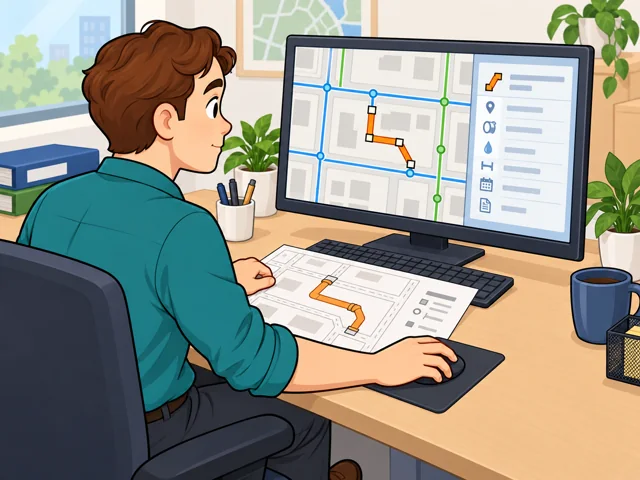
Redraw a changed utility pipe
In utility work, you redraw a changed pipe from construction paperwork, then update its GIS database record.
Career profile
Geographic information system technicians keep digital maps and their linked data correct in GIS software.
Every map line rests on data. Checking that data, adjusting the line to match and making the result usable for someone else is the job.

In utility work, you redraw a changed pipe from construction paperwork, then update its GIS database record.
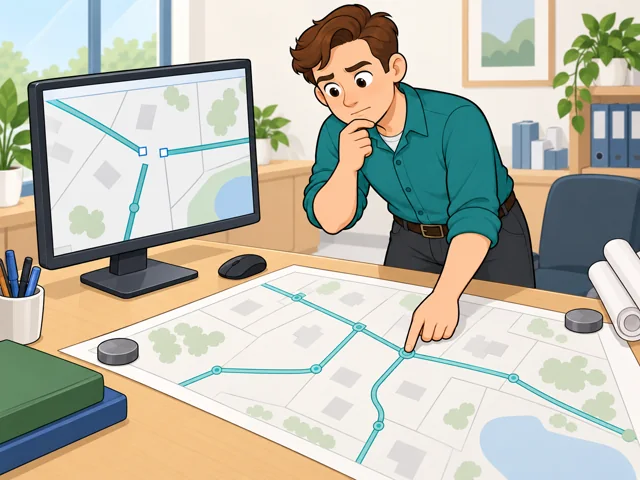
When lines do not meet, check engineering drawings and fix the layer if they show a mistake.

So readers can find what they need, you choose the map's symbols and labels and set its scale.

Ask which records a coworker wants, help pull them up and describe bigger software issues to technical staff.
United States · 2026
Compare the pay range for the specific technician level and location.
Check local technician openings and the experience each requires.
Quick orientation
College certificates and associate degrees teach mapping skills; some entry jobs accept relevant software experience or equivalent training.
Compare the pay range for the specific technician level and location.
Check local technician openings and the experience each requires.
You can connect processing steps in tools such as ArcGIS ModelBuilder and rerun the workflow instead of repeating each operation by hand.
For teams using artificial intelligence to identify objects in images, someone still needs to review the results and assess their accuracy.
How much image tracing shifts into checking machine-produced features will depend on the data and how reliably the tools perform.
Pay in context
Compare pay by location and technician level. These local ranges show concrete possibilities, not a national average.
Kern County, California, lists GIS Technician I at $21.78–$26.03 an hour. That is a classification range, not a guaranteed starting rate.
Des Moines Water Works advertised $33.31–$41.07 an hour, or $69,284.80–$85,425.60 annually, in February 2026. It preferred two to three years of relevant experience.
Kern County lists Technician II at $24.06–$28.76 an hour for more complex work. Its range overlaps Technician I. Differences between employers also reflect different locations and job requirements.
Entry requirements vary. You can prepare through college coursework or relevant experience; entry technicians work with supervision while learning the employer's maps and records.
After entry
This starts where the entry routes leave off: early work, growing capability, and advancement or specialization.
Get comfortable with the employer's map layers and documentation. Practice checking an edit against its source before calling it complete.
Build and test a workflow that processes a recurring dataset. Learn to check intermediate results so you can find which step went wrong.
A Technician II role can add more complex mapping and small projects requiring independent judgment. In Kern County, advancement depends on merit and management approval.
You connect departmental map users with information technology staff, help solve access problems, and document data changes. Some positions include field checks of facilities.
Maps sit alongside construction drawings and utility records. Some roles combine office editing with outdoor asset checks using Global Positioning System (GPS) equipment.
Try it
Sketch five familiar places on paper and give each an ID. Make a table linking each ID to a name and description. Change one place, update both records, and ask someone to find it. Notice whether keeping the map and table consistent feels satisfying.