Set divider strips by the drawing
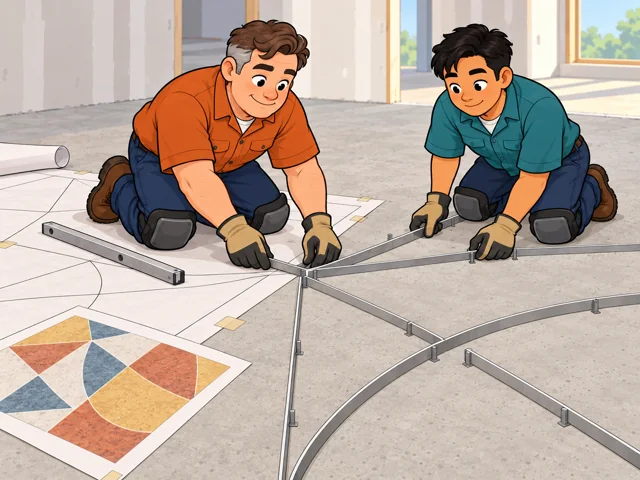
Lay each strip where one color stops and the next starts, guided on some jobs by full-size templates.
Career profile
Terrazzo workers build patterned floors that go down wet, get leveled, then get ground.
Small chips in resin or cement become a design when you mark area borders from a plan drawing, lay the mix and grind it.

Lay each strip where one color stops and the next starts, guided on some jobs by full-size templates.

Weigh and measure each ingredient with scales and marked containers, then load them into a portable mixer.
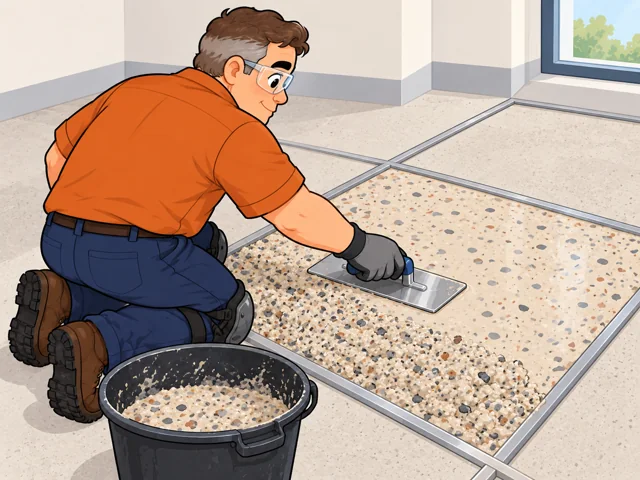
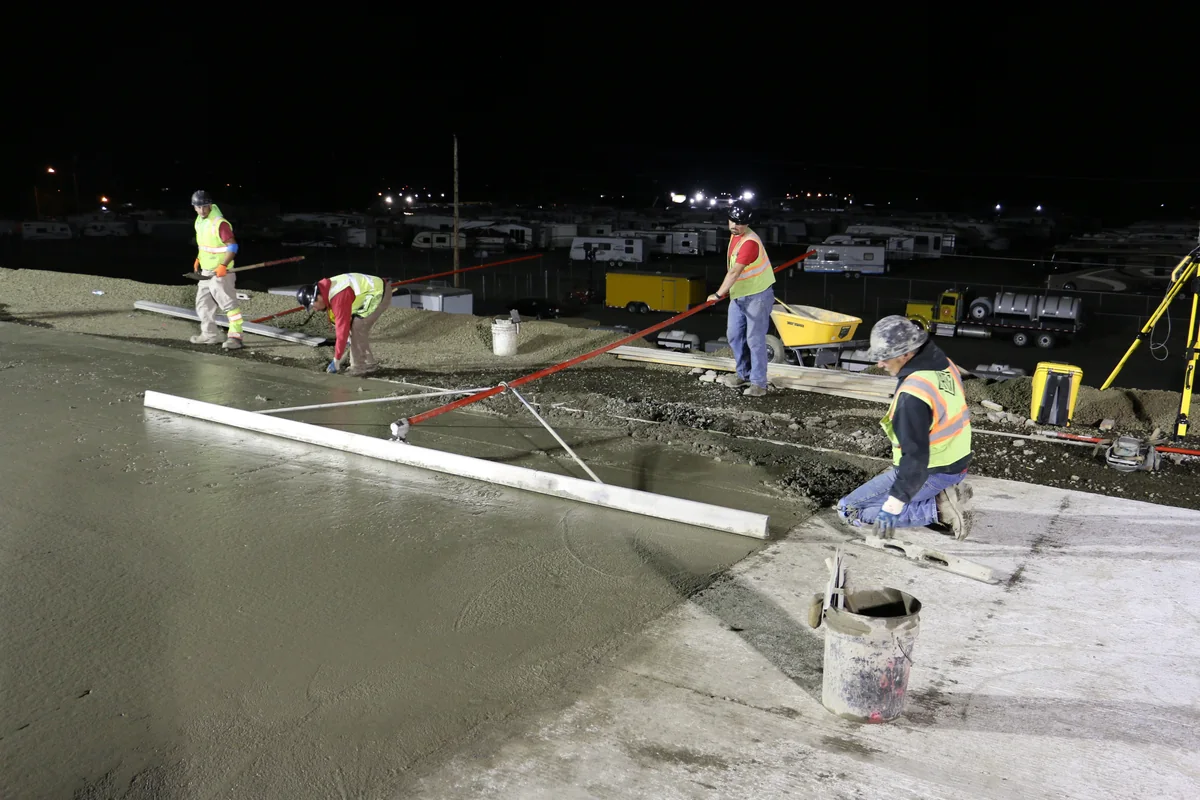
Spread terrazzo mix into one section framed by divider strips, then trowel it to an even surface.

Grind off the hardened rough top to show chips, then fill small dips with same-color grout before finishing.
Quick orientation
Typical preparation for terrazzo workers and finishers; entry requirements vary.
National median for terrazzo workers and finishers, equivalent to $36.62/hour.
Terrazzo workers and finishers: about 100 openings annually despite declining employment.
Digital designs can become full-size layout templates. Some intricate divider assemblies arrive already fabricated, reducing layout work at the site.
You still fit the work to the actual floor. In restoration, exposed damage can change the repair plan, and matching an old surface takes judgment.
More prefabrication could shift work into shops. How much installation moves off-site will depend on the design, available space, and whether the job involves an existing floor.
Pay in context
Use the national figures as a reference when comparing actual offers.
Terrazzo workers and finishers had a median of $76,170 a year ($36.62 an hour). The lowest-paid 10% earned $46,090 or less; the highest-paid 10% earned $126,130 or more. These are wage percentiles, not beginner and expert rates.
Location, experience, and responsibility can affect wages. Ask about the hourly rate and expected hours, including overtime; an annual figure alone does not tell you your likely paycheck.
Employment is projected to fall 13% from 2025 to 2035, with about 100 openings a year nationwide. Declining employment does not mean hiring stops, but these figures cannot tell you whether a nearby contractor is hiring.
A high school diploma or equivalent is typical. You learn the craft through practical training with experienced workers.
After entry
This starts where the entry routes leave off: early work, growing capability, and advancement or specialization.
Get consistent at preparing materials and keeping the installer supplied.
Develop from supporting the pour to laying out divider strips and carrying a section through finishing.
With experience, you could become a foreman coordinating the crew.
On a new floor, the crew works across prepared slabs and pours planned panels. Access to uninterrupted space and time for curing shapes the schedule before grinding begins.
You protect nearby finishes, map damaged areas, and blend repairs into an older floor. Matching its color may be imperfect. If the building stays open, work may happen outside business hours.
Try it
On graph paper, draw a small floor with a two-color border and a doorway. Mark where divider strips would separate the colors, then check that the border stays the same width around corners. Notice whether that careful layout feels satisfying.
Keep exploring