Career profile

Stonemason

Stonemasons cut stone to shape and set it to build walls, paths and other structures.

A stone sometimes needs more cutting before it sits right. Anyone who enjoys making separate pieces fit together exactly will find plenty of puzzles here.
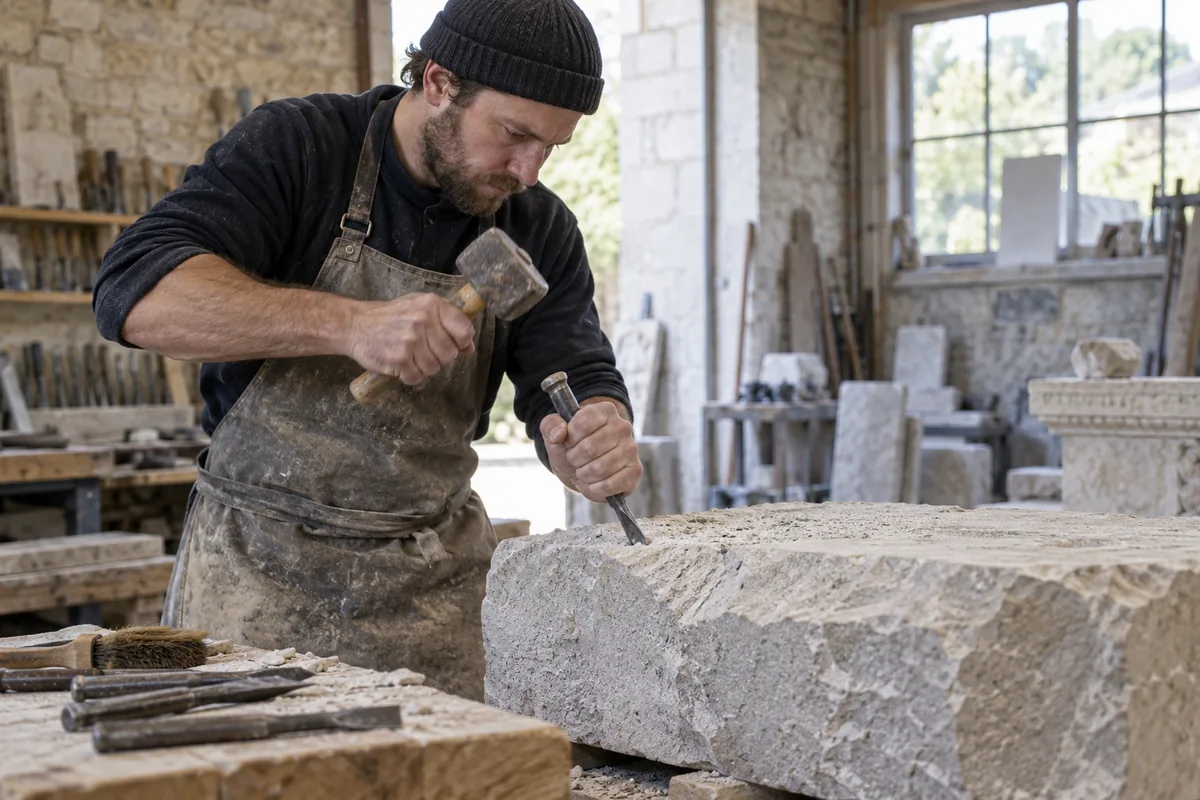
Stonemason shaping a large natural stone block with a hammer and chisel in a stone workshop.

A day in the life

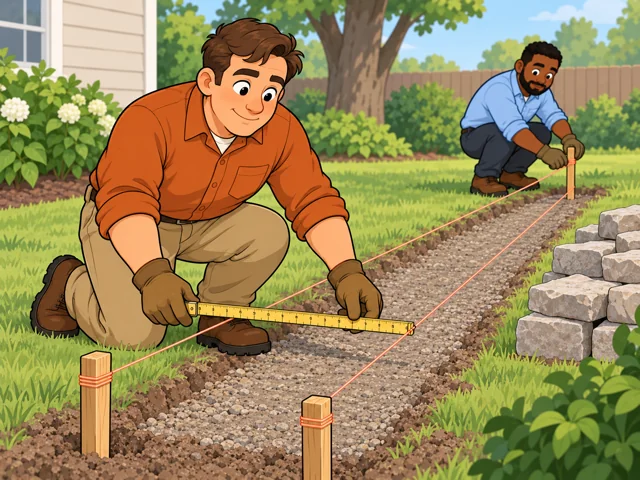
1A stonemason measures the width between staked string lines while a coworker adjusts a stake to lay out a stone wall.

Stake out the wall's line

Before setting any stone, mark the wall pattern with a rule and lines tied between stakes.
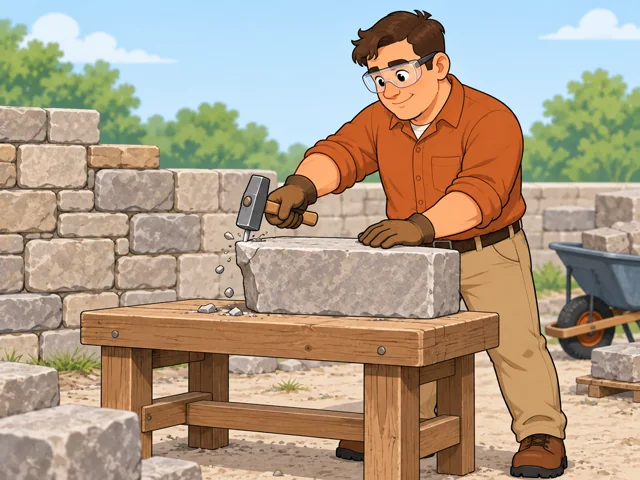
2Wearing safety goggles, a stonemason chips an edge from a securely supported stone with a masonry hammer.

Cut a stone to size

Trim a piece of stone to the required size with a masonry hammer or diamond-blade saw.
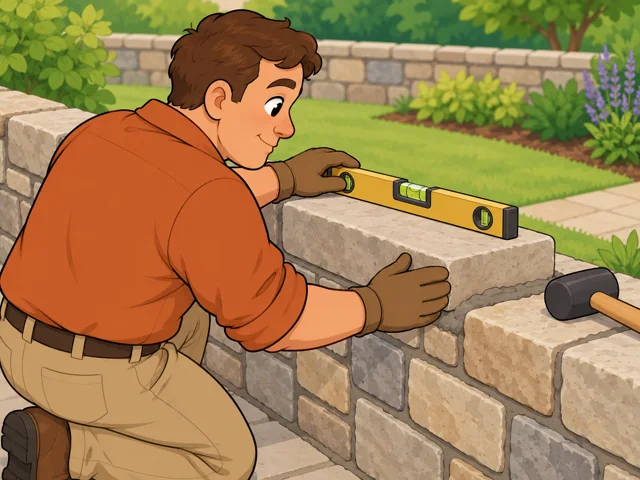
3A stonemason checks a newly placed wall stone with a spirit level while steadying it with one hand.

Set and level each stone

Place the stone, then test it with a level and move it if it isn't lined up.
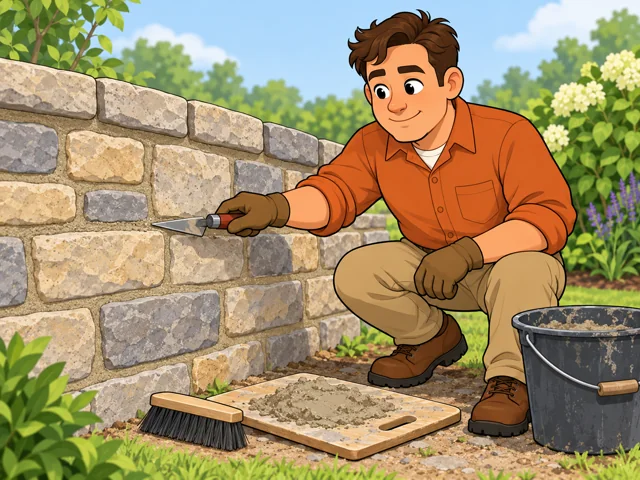
4A crouching stonemason smooths mortar between wall stones with a pointing trowel, with a cleaning brush nearby.

Mortar and smooth the joints

Fill the gaps with mortar, smooth the joints with a trowel, then clean leftover mortar off the stone.

Quick facts

Pay

$57,390

Median/year · May 2025

Outlook

5.4% decline

500 openings/yr

Projected · 2025–35

Preparation

High school

+ trade training

Quick orientation

Preparation, pay & outlook

Preparation

High school + trade training

A high school diploma or equivalent is typical; apprenticeship develops the trade skills.

Geography
United States
Period
2025

Pay

$57,390/year

National median for stonemasons, equivalent to $27.59 an hour.

Geography
United States
Period
May 2025

Outlook

5.4% projected decline

About 500 openings a year are projected nationally, even as total employment falls.

Geography
United States
Period
2025–2035

Fit, tradeoffs & changing tools

Things to weigh

  • Lifting, kneeling, and bending can leave you physically tired.
  • Bad weather can interrupt outdoor work; construction deadlines can bring overtime.

Where AI may help

On some preservation projects, photographs and distance measurements become a three-dimensional wall record, helping crews locate and document repairs.

What people still lead

You still handle the stone and judge how its shape fits the work in front of you.

What we can’t predict yet

More prefabricated panels could shift work away from shaping and setting individual stones onsite. How much your work changes will depend on the projects you take.

Pay in context

Earnings

Use the national figures as a reference when comparing offers, then look at the hours and pay terms.

The middle of the pay range

The median was $57,390 a year, or $27.59 an hour. Half of stonemasons earned more and half earned less; this is not a starting-pay promise.

Geography
United States
Period
May 2025
Pay basis
National employee wage median; annual and hourly estimates

The spread is substantial

The lowest-paid 10% earned below $39,300 annually, while the highest-paid 10% earned above $86,180. These are wage percentiles, not beginner and experienced-worker rates.

Geography
United States
Period
May 2025
Pay basis
National annual employee wage percentiles

Check the working year

Annual figures assume full-time, year-round work, and the wage estimates exclude overtime pay. Weather interruptions and extra hours can change what you actually earn.

Geography
United States
Period
May 2025 wage basis
Pay basis
Annualization and exclusions; actual earnings depend on hours worked

Openings despite a smaller workforce

Stonemason employment is projected to decline 5.4% during 2025–2035, with about 500 openings annually on average. These national projections do not tell you who is hiring nearby.

Geography
United States
Period
2025–2035
Pay basis
Employment projection, not compensation

Getting started

Apply for a stone-masonry apprenticeship

Paid
What the route involves
Combine paid work with experienced craftworkers and required classes. The International Union of Bricklayers and Allied Craftworkers offers stone-masonry training.
What it can lead to
Completing the program develops journey-level craft skills.
What to check
Ask the training coordinator about local admission requirements, program length, and the stonework taught before applying.

Learn through an employer

What the route involves
Learn on the job with experienced masons; some workers begin as construction helpers.
What it can lead to
Work experience can become a route into mason duties.

A high school diploma or equivalent is typical preparation. Look for a route that teaches stonework through practice.

After entry

Career paths

This starts where the entry routes leave off: early work, growing capability, and advancement or specialization.

  1. Get established

    Build consistency in measuring, laying out, and placing stone accurately.

  2. Take on harder fits

    Develop from straightforward shapes to more complex stone shaping and setting.

  3. Lead a crew

    With experience, a foreman role can put you in charge of organizing work on site.

    • Teaching apprentices is another direction for an experienced craftworker.

Where you can work

Exterior construction sites

Building stone walls and exteriors puts you outdoors. Weather affects the working day, and deadlines may require extra hours.

  • Outdoors
  • Physical demands

Historic buildings and park structures

Preservation crews record existing damage and may dismantle and salvage stone for rebuilding. Keeping the original wall pattern matters alongside completing the repair.

  • Field work
  • Outdoors
  • Physical demands

Try it

See whether the job clicks before you commit to the path.

Draw several irregular stone shapes on scrap paper and cut them out. Arrange them into a wall outline with fairly even gaps, then revise the awkward fits. Notice whether you enjoy the repeated choosing, measuring, and adjusting.

Stay safe: Keep this a tabletop paper exercise; it does not test the lifting or tool skills of real stonework.

Explore more careers

Sources

  1. O*NET OnLine. Stonemasons — 47-2022.00. Accessed 2026-10-06.
  2. U.S. Bureau of Labor Statistics. Table 1.2: Occupational projections, 2025–35, and worker characteristics. Accessed 2026-10-06.
  3. CareerOneStop / U.S. Department of Labor. Salary Finder: Stonemasons, United States, May 2025. Accessed 2026-10-06.
  4. CareerOneStop / U.S. Department of Labor. Salary Finder Help. Accessed 2026-10-06.
  5. U.S. Bureau of Labor Statistics. Occupational Outlook Handbook: Masonry Workers. Accessed 2026-10-06.
  6. International Masonry Training and Education Foundation. Careers. Accessed 2026-10-06.
  7. International Masonry Training and Education Foundation. Explore a Career in the Trowel Trades. Accessed 2026-10-06.
  8. National Park Service. Historic Preservation Training Center: Masonry Team. Accessed 2026-10-06.

Your message goes to the Great Jobs team. How we use your information