Career profile

Plasterer or Stucco Mason

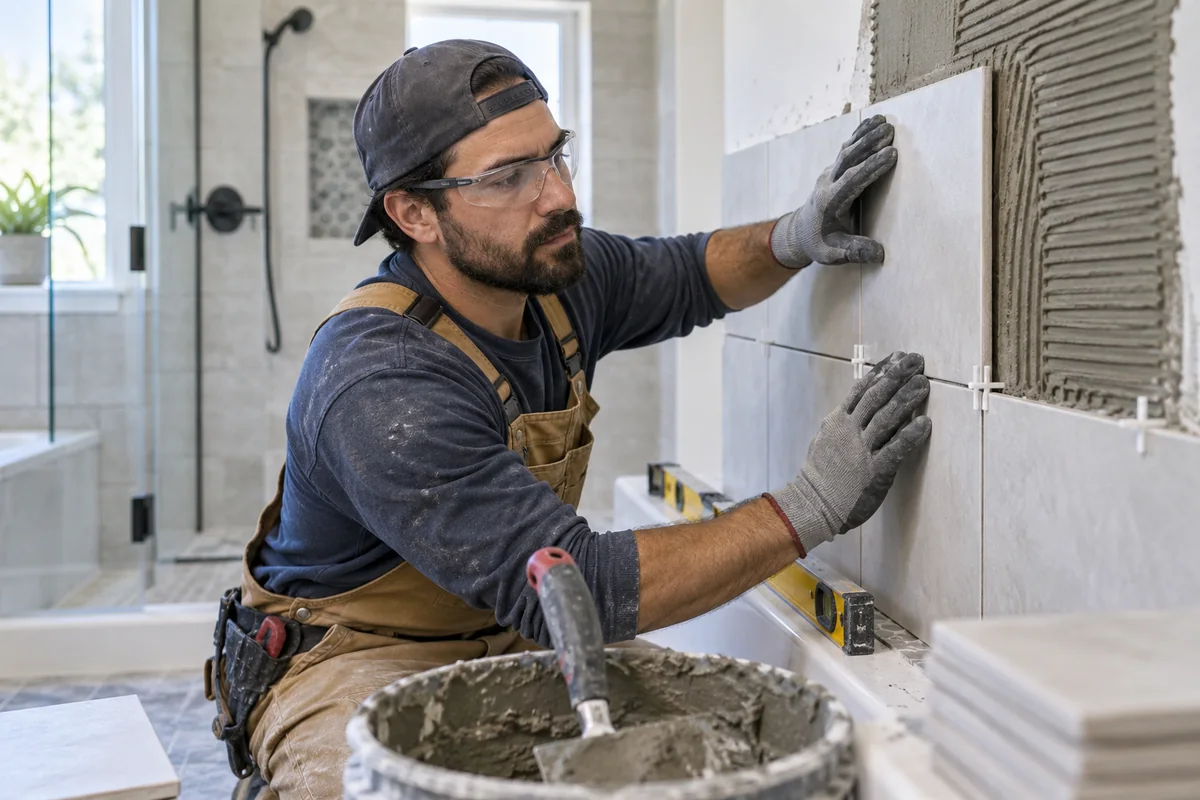
Plasterers and stucco masons turn damp plaster into finished indoor walls or stucco outside walls.

Every finished wall shows your handwork: how flat and smooth it is, how even the texture looks, and the edges along a door opening.
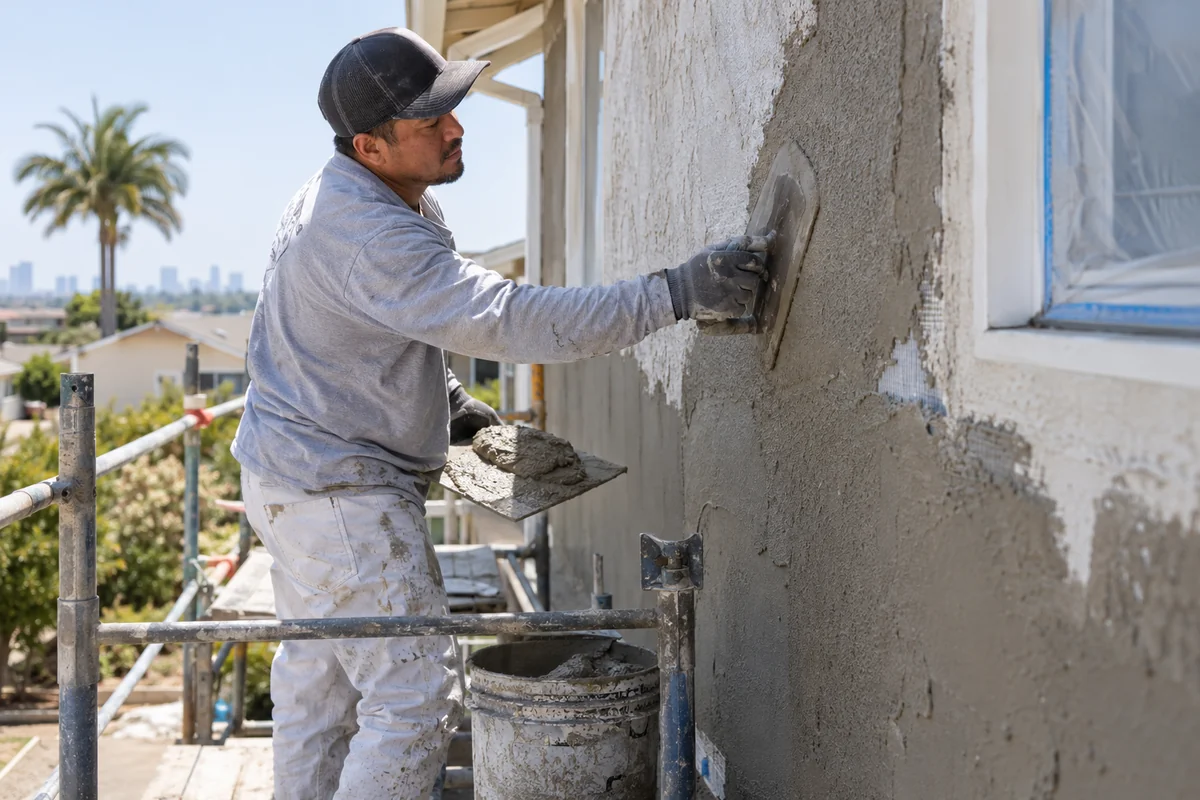
Plasterer applies stucco to an exterior wall with a trowel.

A day in the life

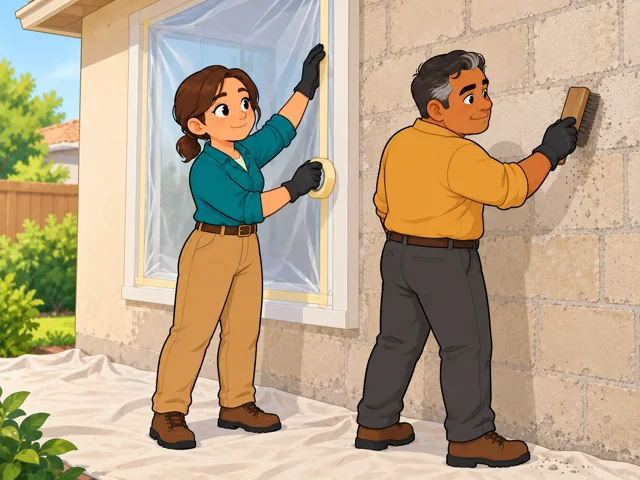
1A plasterer tapes protective plastic around a window while a coworker brushes debris from the nearby exterior wall.

Cover windows before coating

Cover windows and nearby surfaces against splatter, then clean the spot you'll plaster.
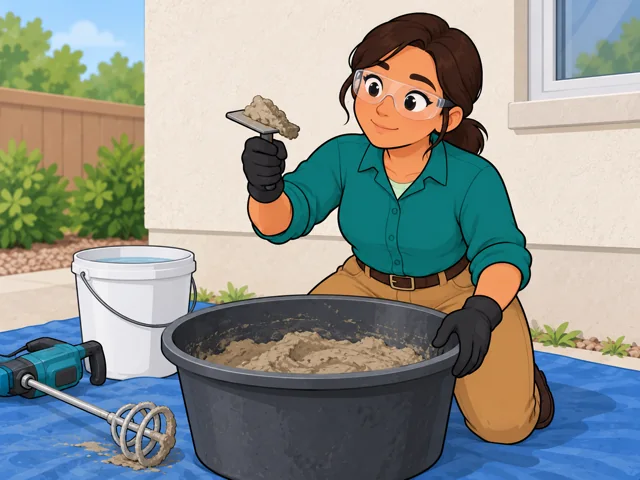
2The plasterer lifts wet stucco on a small trowel above a mixing tub to check its consistency.

Mix plaster and test it

Mix the plaster and test its thickness before applying it, so it suits the coat at hand.
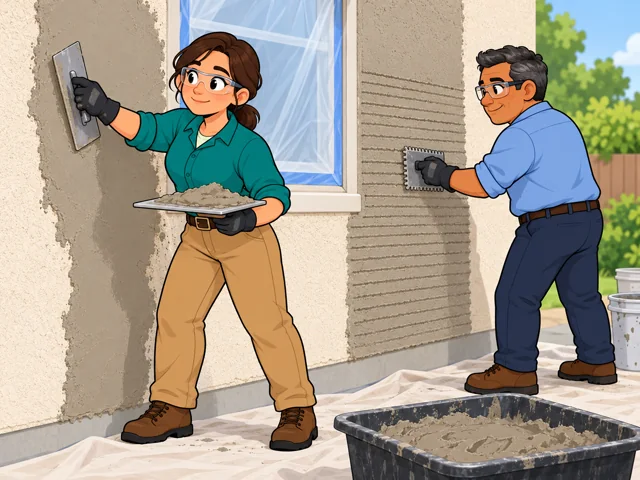
3The plasterer spreads a wet undercoat with a trowel while a coworker scratches parallel grooves into the adjoining section.

Trowel on coats, layer by layer

Trowel on each layer, scratching the undercoat for grip on systems that call for it.
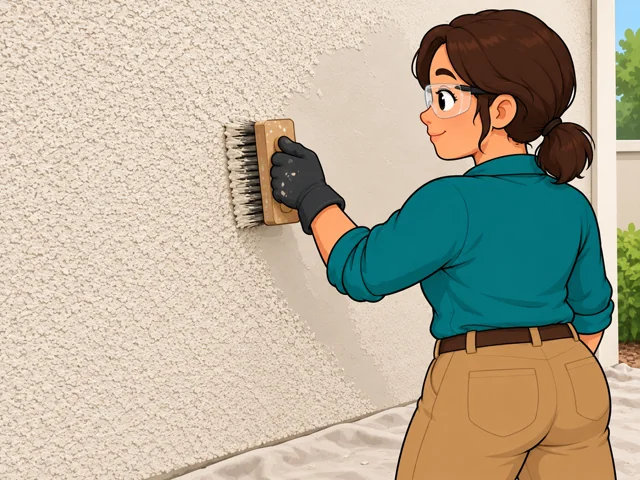
4The plasterer uses a texture brush to extend an even stippled pattern across the wet finish coat.

Work a texture across the wall

With a brush or trowel, repeat the chosen pattern over the whole wall to create its finished texture.

Quick facts

Pay

$57,660

Median/year · 2025

Outlook

2.8% growth

1,500 openings/yr

Projected · 2025–35

Preparation

Learn on the job

Quick orientation

Preparation, pay & outlook

Preparation

Learn on the job

Long-term workplace training is typical. A formal school credential is not generally required, though individual programs set admission rules.

Geography
United States
Period
2025–2035

Pay

$57,660 a year

National median for plasterers and stucco masons; $27.72 an hour.

Geography
United States
Period
2025

Outlook

2.8% projected growth

About 1,500 openings a year on average, including replacement openings.

Geography
United States
Period
2025–2035

Fit, tradeoffs & changing tools

Things to weigh

  • Long periods on your feet, bending, and repeated arm movements can be tiring.
  • Exterior work exposes you to weather; some projects also put you on scaffolding.

Where AI may help

Software can help estimate job costs, and spray equipment can apply some coatings.

What people still lead

You still judge the mix and finish, handle tools, and check the surface.

What we can’t predict yet

How much more application machines will take over—especially around corners and decorative details—remains uncertain.

Pay in context

Earnings

The national midpoint is useful for comparison, but it is not a starting-pay promise.

The midpoint and spread

In 2025, the median was $57,660 a year, or $27.72 an hour. The lowest-paid 10% earned $39,560 or less; the highest-paid 10% earned $96,710 or more. These are wage percentiles, not beginner and expert pay grades.

Geography
United States
Period
2025
Pay basis
National annual and hourly wages for employees in SOC 47-2161

How training can change your rate

The Operative Plasterers' and Cement Masons' International Association describes scheduled raises during apprenticeship and journey-worker wages after completion. Ask the local sponsor for its actual wage schedule and progression rules.

Geography
United States
Period
Not stated
Pay basis
Union apprenticeship wage progression; no local dollar rate asserted

What the openings mean

Employment is projected to grow 2.8% from 2025 to 2035, with about 1,500 openings annually on average. Openings include replacing people who leave the occupation, so they exceed the number of newly added jobs.

Geography
United States
Period
2025–2035
Pay basis
Employment projection for SOC 47-2161; not a compensation measure

Getting started

Start as a plastering helper

What the route involves
Supply materials, clean tools, and help prepare the work area while learning from experienced plasterers.
What it can lead to
Experience can help you move into plastering work as you learn application and finishing skills; the move is not automatic.
What to check
Some employers prefer a high school diploma or equivalent and may require safety training or a driver's license. Check the specific opening.

Apply for a plastering apprenticeship

Paid
What the route involves
Combine paid work with classes in tools, material mixes, drawings, repair, and jobsite safety.
What it can lead to
Completing the union apprenticeship moves you from apprentice to journey worker.
What to check
A local sponsor reviews your application. Ask it to confirm admission requirements, training length, and how work placements are arranged.

You can enter through workplace training without first earning a college degree. Two routes put you alongside experienced plasterers.

After entry

Career paths

This starts where the entry routes leave off: early work, growing capability, and advancement or specialization.

  1. Get established

    Build reliable habits with tools, mixing, surface preparation, and safe access to the work.

  2. Handle more varied jobs

    Learn to read drawings and extend your skills into repair and restoration, where the existing work shapes what you do next.

  3. Specialize in ornamental plaster

    Develop the precision to mold and install decorative plaster pieces, panels, and trim.

Where you can work

Interior walls and ceilings

Homes, offices, and schools put you inside rooms, sometimes reaching overhead to coat ceilings. Doors, windows, and nearby finishes need protection from splashes.

  • Indoors
  • Physical demands

Exterior stucco crews

You work outdoors, sometimes from scaffolding. Depending on the wall system, the work includes fixing mesh or lath beneath the stucco coats.

  • Outdoors
  • Physical demands
  • Safety-sensitive

Try it

See whether the job clicks before you commit to the path.

Spread soft modeling clay over a small piece of cardboard with a plastic scraper. Smooth one half and repeat a texture on the other. Notice whether you enjoy controlling the tool and correcting uneven spots.

Stay safe: Use modeling clay, not construction plaster or cement. This explores hand control, not real plaster mixing or curing.

Explore more careers

Sources

  1. O*NET OnLine. 47-2161.00 — Plasterers and Stucco Masons. Accessed 2026-10-05.
  2. O*NET OnLine / U.S. Bureau of Labor Statistics. 2025 wages for Plasterers and Stucco Masons — United States rows. Accessed 2026-10-05.
  3. U.S. Bureau of Labor Statistics. Occupational projections and worker characteristics, 2025–2035. Accessed 2026-10-05.
  4. U.S. Bureau of Labor Statistics. Construction Laborers and Helpers. Accessed 2026-10-05.
  5. Operative Plasterers' and Cement Masons' International Association International Training Fund. Apprenticeship. Accessed 2026-10-05.
  6. Operative Plasterers' and Cement Masons' International Association. Earn While You Learn. Accessed 2026-10-05.
  7. Operative Plasterers' and Cement Masons' International Association International Training Fund. The OPCMIA Crafts. Accessed 2026-10-05.
  8. U.S. Department of Labor, Job Corps. Plastering, Pre-Apprentice. Accessed 2026-10-05.

Your message goes to the Great Jobs team. How we use your information